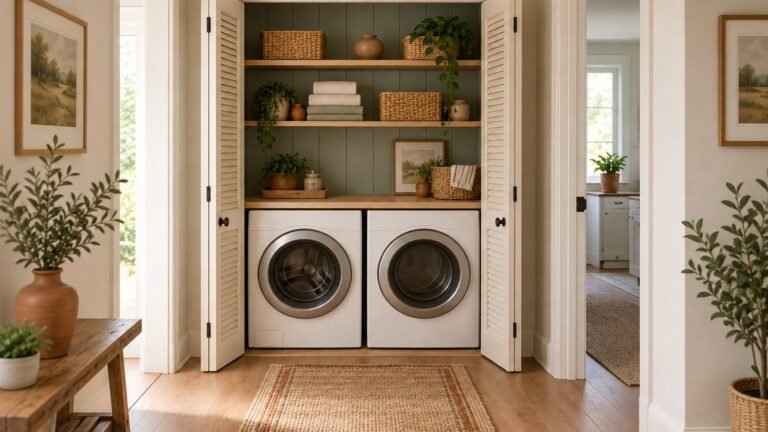
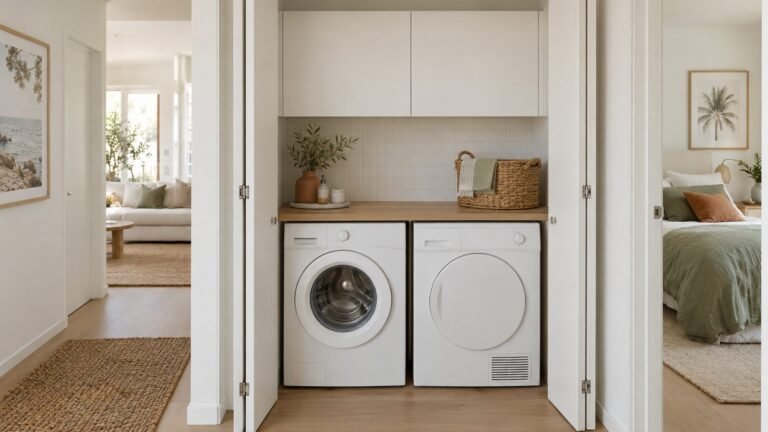
The right laundry room cabinet ideas can turn a wall of loose bottles and a wobbly wire shelf into a room that feels finished. Cabinets hide the visual noise of detergent, cleaning sprays and spare towels, and when you plan them around the washer and dryer, they also give you a place to fold, sort and hang clothes.
This guide covers 18 practical ideas for upper, base and tall cabinets, plus small-room and budget options. Before you shop, it walks through the measurements that matter most around washers and dryers, the main cabinet types and what they roughly cost, and the safety rule every family with small children should know.
Key Takeaways
- Quick answer: the best laundry room cabinet setup pairs wall cabinets above the machines with base cabinets or a tall cabinet beside them, so supplies sit behind doors and a counter gives you a folding spot.
- Measure before you buy: front-loaders are about 39 in (99 cm) tall, and top-loaders need about 2 ft (61 cm) of clear space above for the lid, so your machine type decides whether a counter can go on top.
- Keep detergent and laundry pods in a high, locked cabinet, never on top of the machines or in drawers under them.
Time: a weekend for flat-pack cabinets · Cost: about $250 to $2,000+ · Difficulty: Easy to moderate
Measure Around Your Washer and Dryer First
Laundry cabinets have to work around two large machines, so start with their sizes, not with the cabinet catalog. According to the Whirlpool laundry sizing guide, a typical front-load washer is about 27 in wide, 39 in tall and 32–34 in deep, a stacked front-load pair is about 78 in tall, and a top-load washer needs about 2 ft of clearance above it so the lid can open. The same guide suggests leaving about 1 in on each side and 6 in behind the machines for hoses and venting.
Those numbers explain the most common planning mistakes. A standard kitchen counter is about 36 in high, which is lower than most front-loaders, so a counter over the machines has to sit higher. Front-loaders are also deeper than a standard 24 in (61 cm) base cabinet, so they usually stick out past a normal cabinet run unless you plan for it. To check your own room, try our washer and dryer space calculator.
Safety matters just as much as fit. The American Academy of Pediatrics laundry room safety advice says to put laundry products out of sight and reach of children and pets, notes that “a high, locked cabinet is best,” and warns against keeping them on top of the washer and dryer or in storage drawers under laundry machines. It also recommends keeping detergent in its original container with the label and closing it tightly after use.
Quick Pick: Which Cabinet Idea Fits Your Room?
| Your laundry space | Best cabinet idea | Why it works |
|---|---|---|
| Side-by-side front-loaders | Counter on top + wall cabinets | Adds a folding surface and closed storage in one wall |
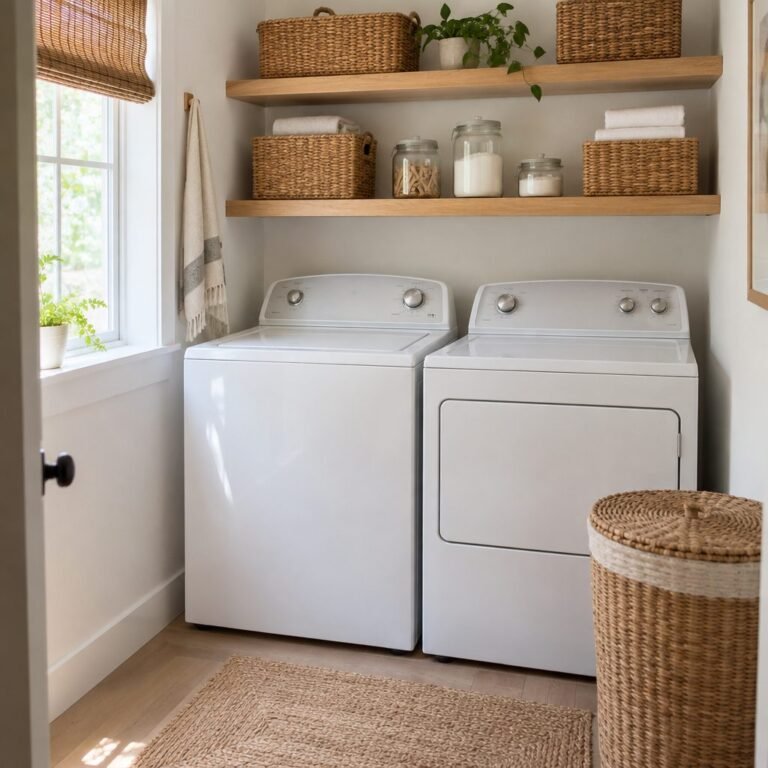
| Top-loading washer | Tall cabinet beside it + high uppers | Keeps the space above the lid clear |
| Stacked pair in a closet | Shallow cabinet above the stack | Uses the dead space up to the ceiling |
| Small room, no space for uppers | Base cabinets + open shelves | Feels lighter and costs less |
| Tight budget | Flat-pack base cabinets, painted | Ready-made boxes at a lower price |
| Small children at home | High cabinet with a lock | Keeps detergent and pods out of reach |
Laundry Cabinet Types and What They Cost
Most laundry rooms use the same cabinet boxes as kitchens: base cabinets (usually about 34.5 in tall and 24 in deep, before the counter), wall cabinets (usually about 12 in deep) and tall cabinets for brooms and bulky items. Where they differ is how they are made and sold.
- Ready-to-assemble (flat-pack): the cheapest option. You build the boxes yourself, and they come in standard widths only. Good for a straight wall of base cabinets.
- Stock cabinets: pre-built in standard sizes and finishes, sold at home centers. Quick to get and easy to install.
- Semi-custom cabinets: standard boxes with more sizes, depths and finishes, which helps around deep machines or awkward corners.
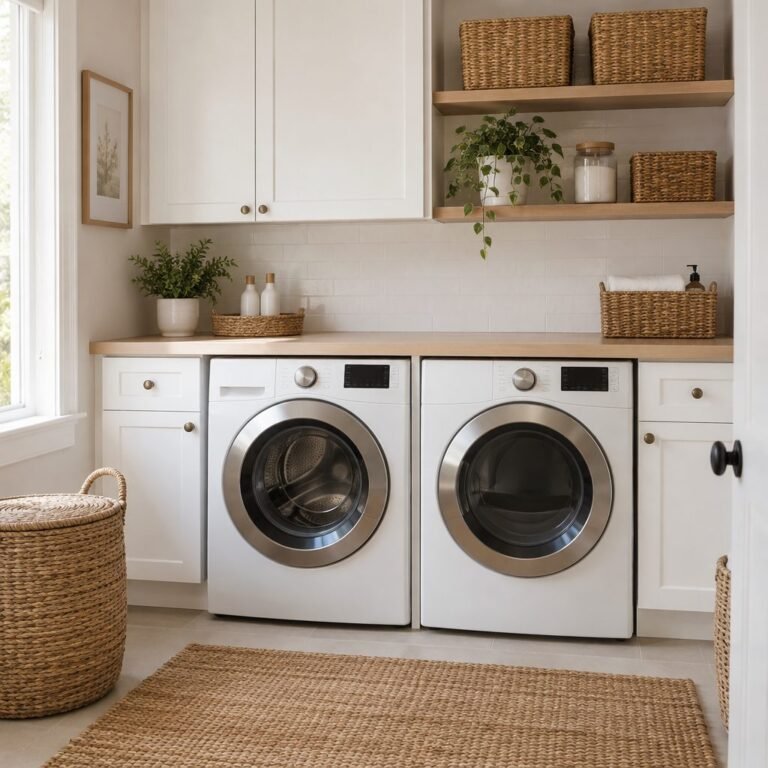
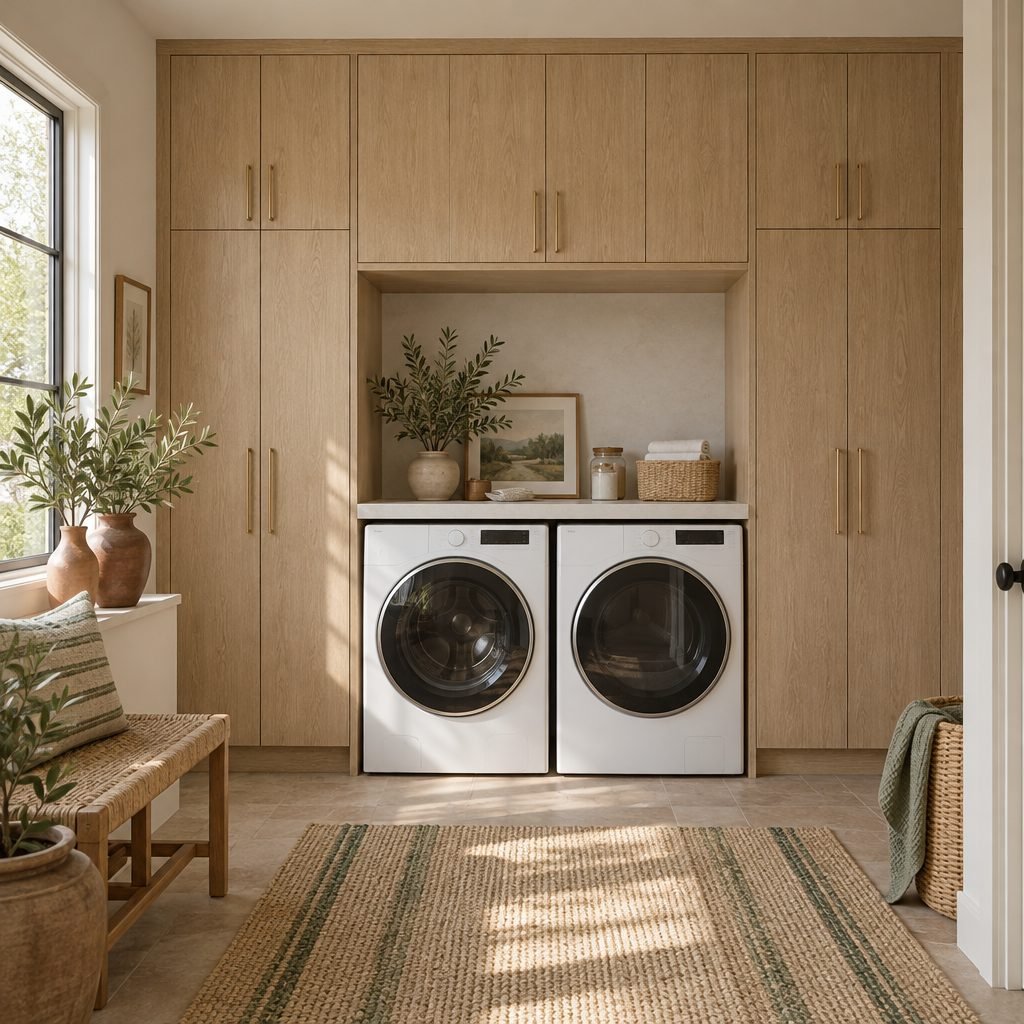
- Custom cabinets: built for your exact room. The most expensive, but the best choice for a full wall like the one in the photo above.
As a rough guide, Bob Vila’s laundry room remodel cost guide puts laundry room cabinets at around $250 at the low end and as high as $2,000 at the upper end, with countertops from about $300 to $1,400 depending on the material. Prices vary a lot by region and size, so treat these as a starting point and get quotes for anything custom.
How to Plan Laundry Room Cabinets in 5 Steps
- Measure the wall width, ceiling height and the exact size of your machines, including the open door or lid.
- Decide where you need a folding surface and where you need tall storage for a broom, mop or ironing board.
- Sketch the wall: machines first, then tall cabinets at the ends, then base cabinets and uppers in the gaps.
- Pick one high, lockable cabinet for detergent, pods and stain removers before you plan anything else.
- Choose moisture-friendly finishes and hardware, then order or build one section at a time.
Full-Wall and Upper Cabinet Ideas
1. Run cabinets from floor to ceiling around the machines
The most finished look is a full wall of cabinets with a built-in nook for the washer and dryer, like the white oak wall at the top of this guide. Tall cabinets at each end hold bulky items, uppers fill the space above the counter, and everything shares one finish, so the machines look built in rather than parked against a wall.
2. Use glass-front uppers for things you reach every day
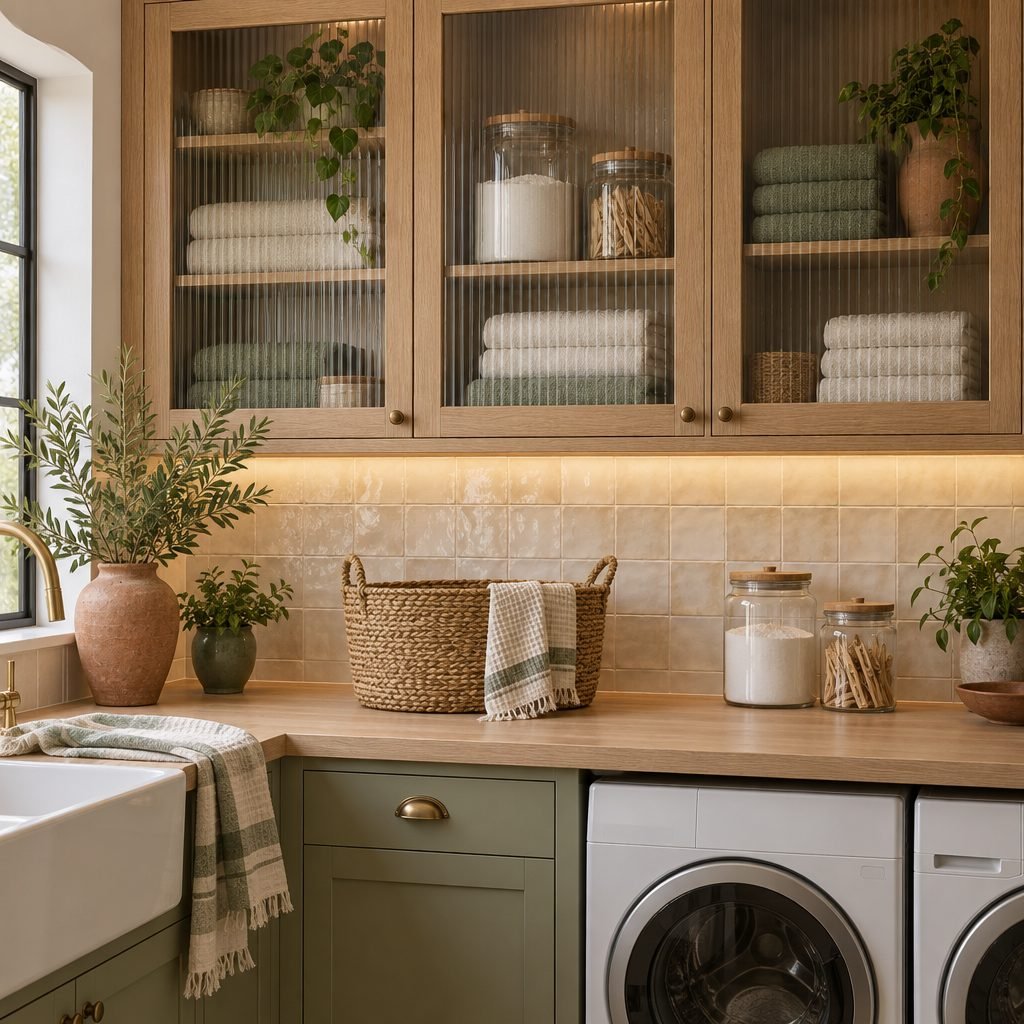
Glass doors keep dust off towels and supplies but still let you see what is inside. Reeded or frosted glass blurs the contents, so slightly mismatched bottles look calm. Keep the glass cabinets for neat items such as folded towels and clothespins, and put mismatched cleaning products behind solid doors.
3. Add lighting under the wall cabinets
Uppers cast a shadow over the counter, which makes it harder to spot stains while you sort. A strip of LED lights under the cabinets fixes this. Plug-in and battery strips are an easy start; for wired lights, hire an electrician, and keep any cords well away from a utility sink.
Base Cabinet and Counter Ideas
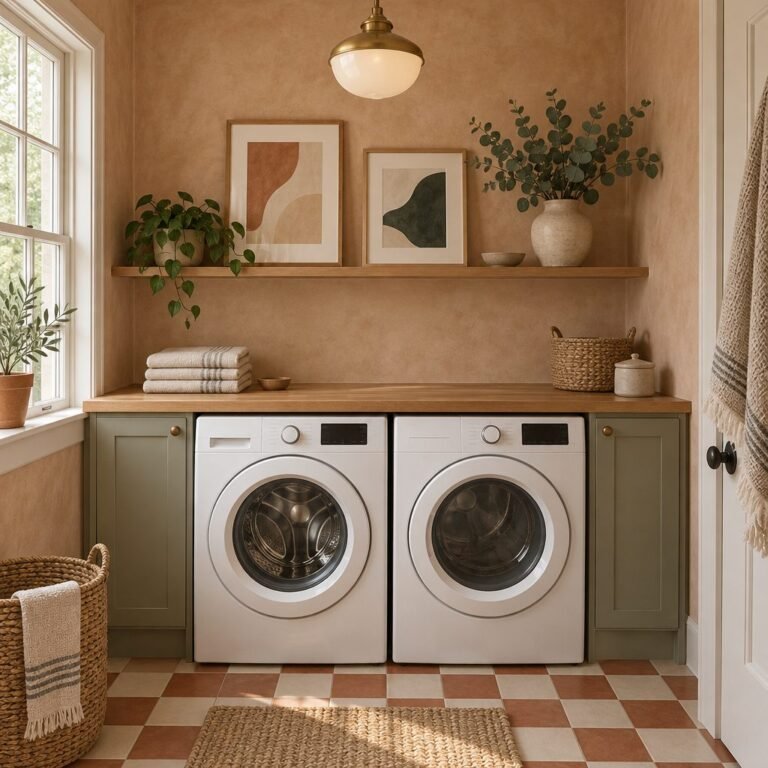
4. Put a counter over front-loaders
A counter across side-by-side front-loaders gives you a long folding surface without losing floor space. Because most front-loaders are about 39 in tall, the counter has to sit higher than a kitchen counter, with a gap of about 1 in above the machines so their vibration does not shake it. Support it on base cabinets at each end and wall cleats along the back, never on the machines themselves. This only works with front-loaders; a top-loader needs the space above it clear.
5. Build in pull-out hamper baskets
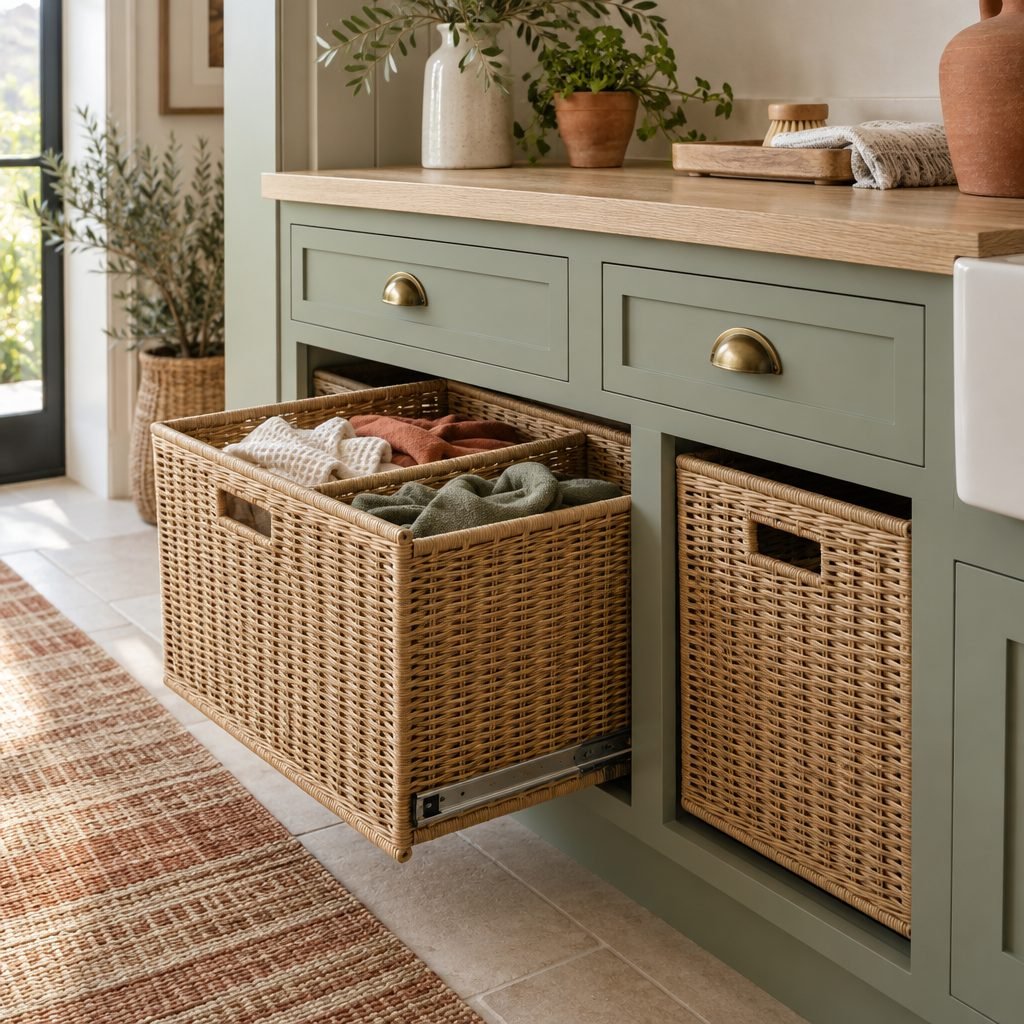
Swap the shelves in a base cabinet for baskets on full-extension drawer slides. One basket for lights, one for darks and one for towels means laundry is sorted the moment it comes off the floor. Pick baskets with handles and liners so you can carry them straight to the washer.
6. Add a row of drawers for small supplies
Shallow drawers above the baskets hold the small things that clutter a counter: lint rollers, sewing kits, spare buttons, clothespins and stain sticks. Keep detergent and pods out of these low drawers if children are around; they belong in a high, locked cabinet instead.
7. Fit a utility sink into the base cabinets
A sink set into a run of base cabinets is handy for soaking stains, hand-washing delicates and rinsing muddy boots. The cabinet below hides the plumbing, and a sink base with doors leaves room for a bucket and spare sponges.
8. Mount a drying rack above the base cabinets
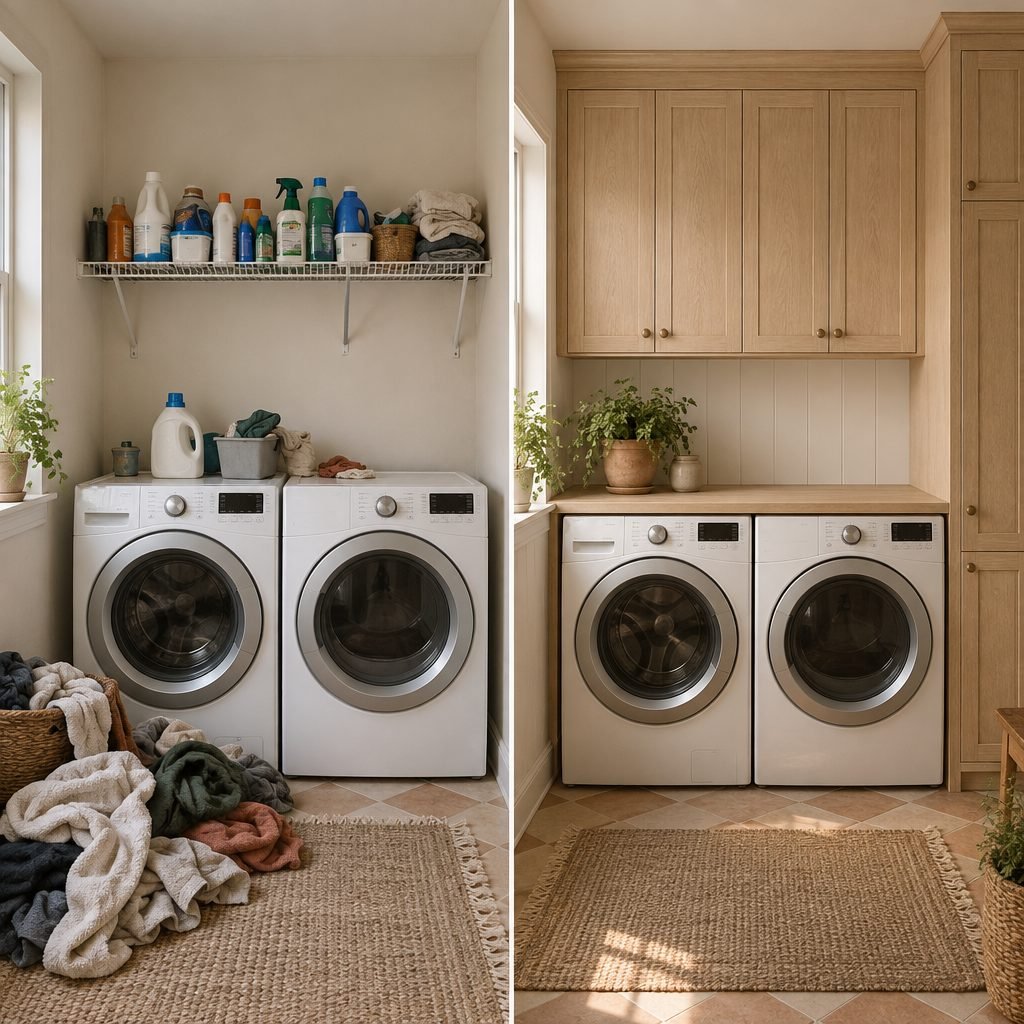
A wall-mounted rack above the counter, like the one in the budget photo below, dries delicates and towels without taking floor space. Choose one that folds flat against the wall, and hang it high enough that wet items do not drip onto the counter below.
Tall Cabinet Ideas
9. Give the broom and vacuum their own tall cabinet
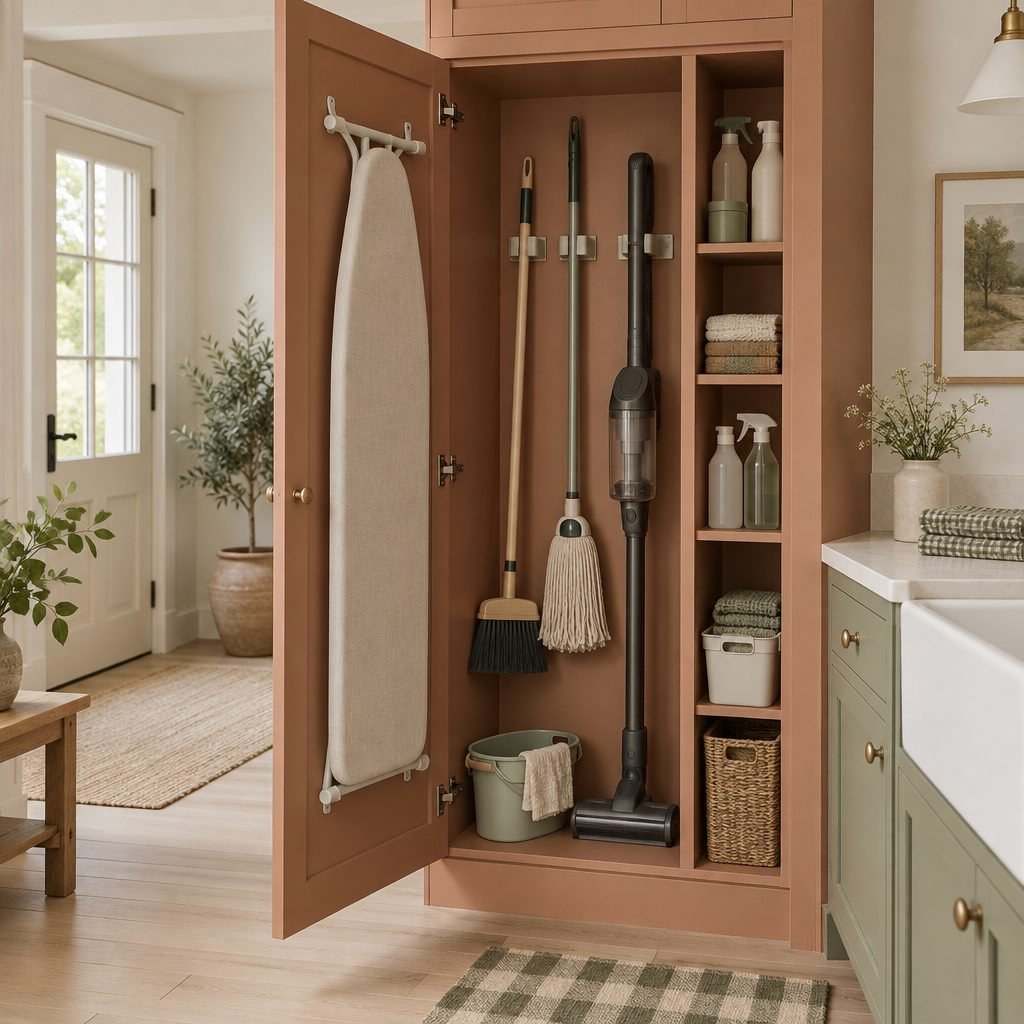
A tall cabinet at the end of the laundry wall swallows the awkward items that never fit anywhere else: broom, mop, bucket and a stick vacuum. Wall clips keep the handles upright, and narrow shelves down one side hold sprays and cloths. Painting just this one cabinet in a warm color, such as terracotta, turns it into a feature.
10. Hang the ironing board on the inside of the door
Mount a pair of ironing board hooks on the inside of a tall cabinet door so the board is out of sight but ready in seconds. Use a solid door with sturdy hinges and screw the hooks into the frame of the door, not just the thin center panel.
11. Make one high cabinet the locked supply cabinet
If young children or pets visit your laundry room, choose one upper cabinet, or the top section of a tall cabinet, for detergent, pods, bleach and stain removers and fit it with a cabinet lock. This follows the AAP advice above and is one of the most important cabinet decisions in a family home. Keep each product in its original, labeled container.
Small Laundry Room Cabinet Ideas
Small laundry room cabinet ideas focus on depth and height rather than width. When there is no room for a full wall, these four tricks still add useful storage.
12. Pair base cabinets with open shelves instead of uppers
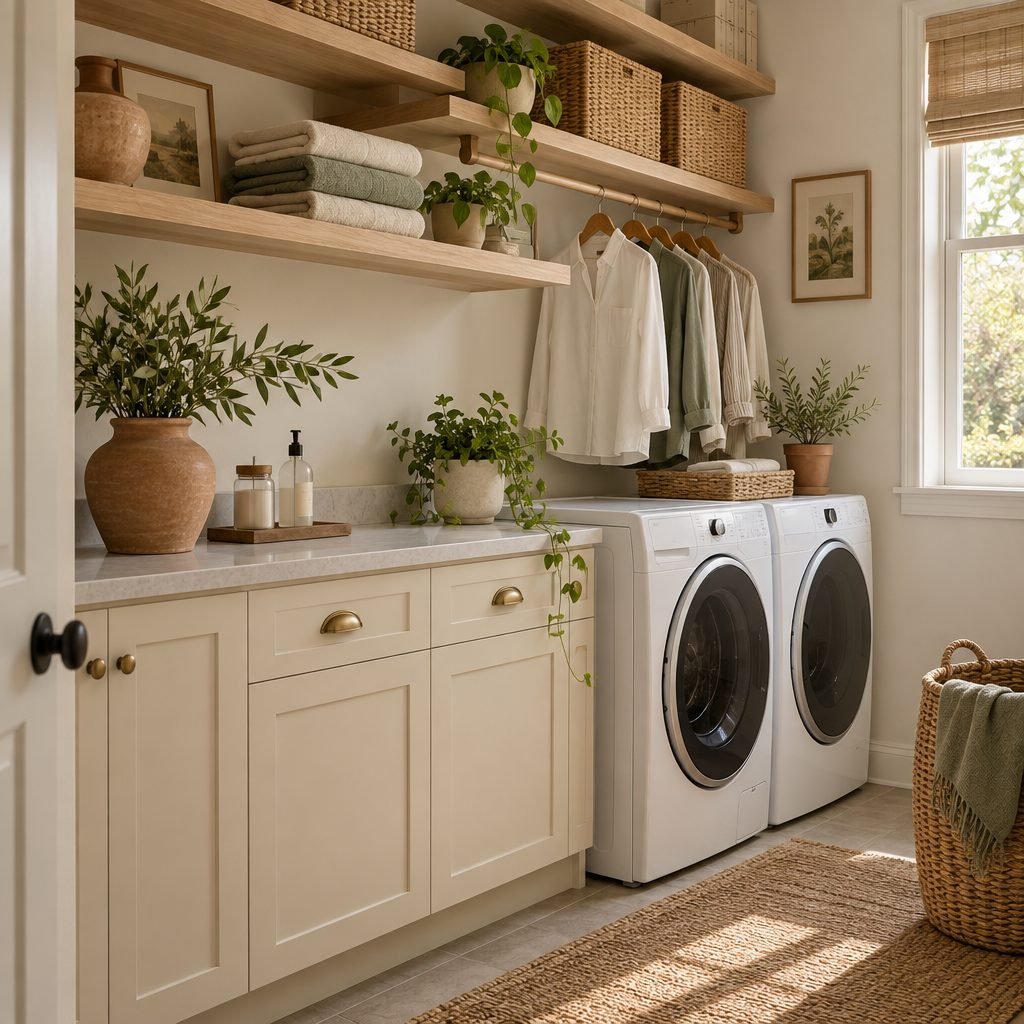
In a narrow room, a row of upper cabinets can feel heavy. Base cabinets with a counter, plus two open shelves above, give you useful storage that feels lighter. Keep the shelves tidy with matching baskets, and see our guide to DIY floating shelves if you want to build them yourself.
13. Add a hanging rod under the shelves
A short rod mounted under a shelf or upper cabinet lets you hang shirts straight from the dryer, so they do not wrinkle while waiting to be put away. It only needs about the length of a few hangers to be useful.
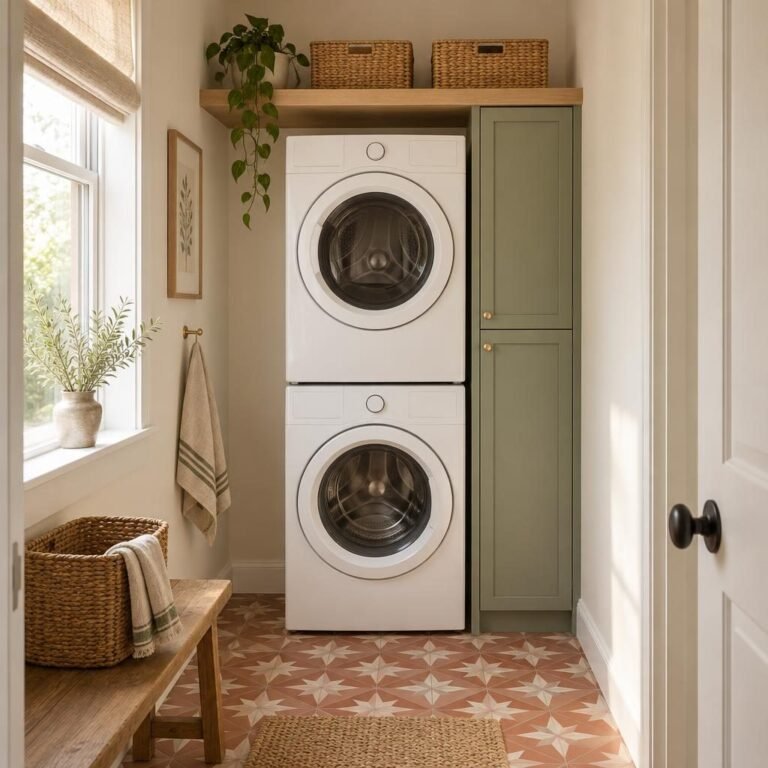
14. Fit a shallow cabinet above a stacked pair
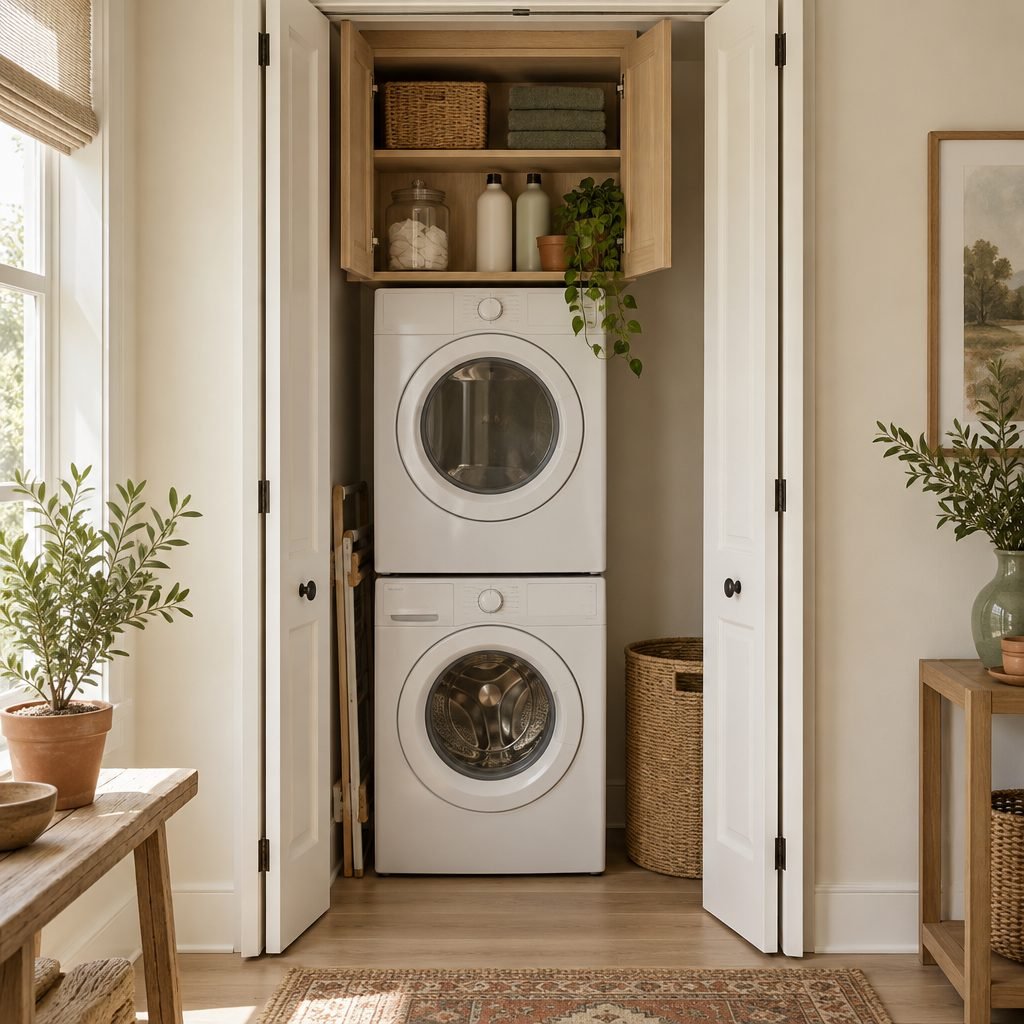
A stacked washer and dryer is about 78 in tall, so in a room with an 8 ft (96 in) ceiling there is only a short space left above it. A shallow wall cabinet fills that gap with storage for spare towels, dryer sheets and refills. Hang it a few inches above the stack, and remember you will need a small step stool to reach it.
15. Slide a slim pull-out into the gap beside the machines
If you have a few spare inches between the machines and a wall, a slim rolling cart or pull-out cabinet made for that gap can hold sprays and stain removers. Leave the side clearance your machines need, and keep anything harmful higher up if children are around.
Budget Laundry Room Cabinet Ideas
16. Use flat-pack kitchen base cabinets
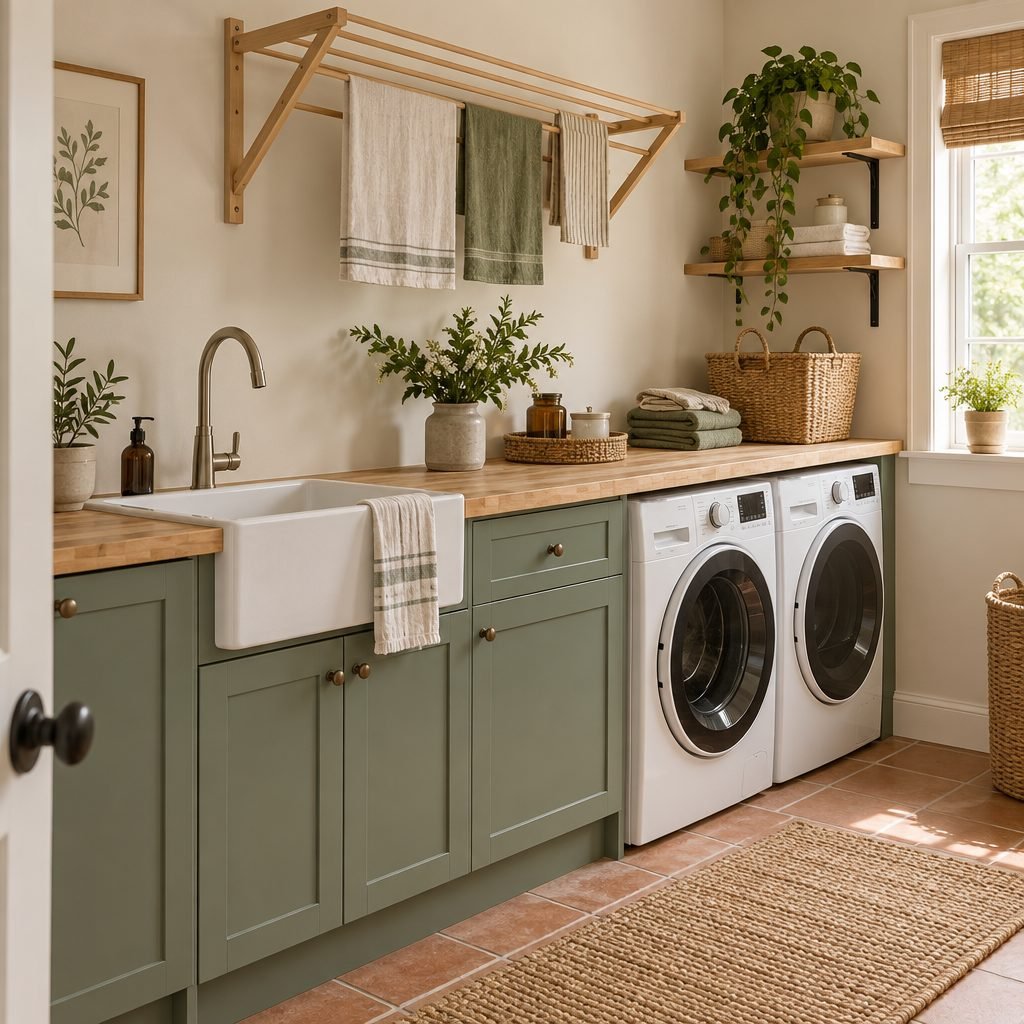
Ready-to-assemble kitchen base cabinets are one of the cheapest ways to add closed storage. Line them up along one wall, top them with a butcher block counter and add a simple drop-in or farmhouse sink if you have the plumbing. Seal a wood counter well, because a laundry room sees water and steam.
17. Paint the cabinets you already have
If the boxes are solid, a new color and new hardware can change the whole room. Sage green, warm cream and soft terracotta all suit a laundry room. Clean and sand the doors, use a primer, then a durable cabinet paint, and finish with brass or black pulls.
18. Look for secondhand cabinets
Kitchen remodels often leave good cabinets behind. Habitat for Humanity ReStores, local marketplaces and salvage yards can be a source of base and wall cabinets for a fraction of the new price. Measure carefully before you buy, and check that the boxes are not swollen from water.
Laundry Cabinet Mistakes to Avoid
- Putting a counter over a top-loader. The lid needs about 2 ft of clear space to open.
- Using a standard 36 in counter height over front-loaders. Most are about 39 in tall, so the counter has to sit higher.
- Resting the counter on the machines. Support it on cabinets and wall cleats instead, and leave a small gap.
- Forgetting the depth of the machines. Front-loaders are deeper than standard base cabinets, and they need space behind for hoses and the vent.
- Storing pods and detergent low. Keep them in a high, locked cabinet, not on the machines or in drawers under them.
- Choosing finishes that hate moisture. Unsealed wood and raw particleboard edges can swell in a damp room.
FAQ
What kind of cabinets are best for a laundry room?
Most laundry rooms use kitchen-style base, wall and tall cabinets. Pick boxes with sealed edges and a wipeable finish, solid doors for cleaning products and glass doors only for neat items. Flat-pack cabinets suit a budget; semi-custom or custom cabinets suit rooms with awkward sizes.
How deep should laundry room cabinets be?
Standard wall cabinets are about 12 in (30 cm) deep and standard base cabinets about 24 in (61 cm) deep. Remember that front-loaders are deeper than a standard base cabinet, so plan for the machines to sit forward of the cabinet line or use deeper custom cabinets around them.
How high should cabinets be above a washer and dryer?
Above a counter, wall cabinets usually start about 15–18 in (38–46 cm) higher, as in a kitchen. Above a top-loader, keep about 2 ft (61 cm) clear for the lid. Above a stacked pair, which is about 78 in tall, there is usually only room for a shallow cabinet.
Can I use kitchen cabinets in a laundry room?
Yes. Kitchen base, wall and tall cabinets work well in a laundry room and are easy to find. Just check the depth around your machines, use a moisture-resistant counter and keep one high, lockable cabinet for detergent.
Laundry in a hallway closet rather than a full room? Our laundry closet ideas show which cabinets and shelves still fit behind the doors.
Final Thoughts
The best laundry room cabinet ideas start with the machines: measure them, decide where the counter and tall storage go, and choose one high, locked cabinet for anything harmful. After that, pick the ideas that fit your room and budget, from a full built-in wall to a few painted flat-pack base cabinets.
For more ways to use a tight space, see our small laundry room ideas, our guide on how to organize a laundry room and our ideas for a small laundry room with a top-loading washer. Once the cabinets are in, learn how to fold clothes to save space so towels and sheets fit neatly on the shelves, and borrow a few tricks from our linen closet organization guide.
How this guide was made: researched and written with the help of AI tools, fact-checked against trusted sources and published by Mohamed Elber. Images are AI-generated illustrations. See our Editorial Policy.