How many boxes do you need to move? This free moving box calculator estimates how many small, medium, large, wardrobe and dish boxes your home needs, room by room, plus the packing tape and paper to buy.
Pick your home size, change the rooms to match yours and say how much stuff you own. A typical two-bedroom apartment is filled in, and the box list updates as you type, so you can copy it or print it before you shop.
How many moving boxes do you need?
Pick your home size, adjust the rooms and how much stuff you have, and get the number of small, medium, large, wardrobe and dish boxes, plus the packing tape and paper to buy.
Your box list
| Box | Typical size | Pack | Qty |
|---|
Boxes by room
| Room | Small | Med | Large/XL | Other |
|---|
Packing supplies
Packing tips
How it works: each room type has a typical mix of box sizes (for example a kitchen needs mostly small and medium boxes plus dish packs, a bedroom more large boxes and a wardrobe box), adjusted for how much you own. Totals land inside the ranges moving companies publish for each home size. Box sizes are typical US moving boxes and vary by store. Results are planning estimates, so check your closets, cabinets and garage before you buy.
Embed this calculatorFree for your blog or website
Copy the code and paste it into an HTML block on your site. It is free to use; please keep the credit link under the calculator.
<iframe class="dsh-embed" src="https://dailyspacehacks.com/embed-calculators/moving-boxes/" title="Moving Box Calculator" width="100%" height="2540" style="border:0;width:100%;max-width:760px;display:block" loading="lazy"></iframe>
<p style="font-size:13px;margin:6px 0 0"><a href="https://dailyspacehacks.com/moving-box-calculator/">Moving Box Calculator</a> by Daily Space Hacks</p>
<script>window.addEventListener('message',function(e){if(e.origin!=='https://dailyspacehacks.com'||!e.data||!e.data.dshEmbed)return;document.querySelectorAll('iframe.dsh-embed').forEach(function(f){if(f.contentWindow===e.source)f.style.height=e.data.h+'px'})});</script>How Many Moving Boxes Do I Need?
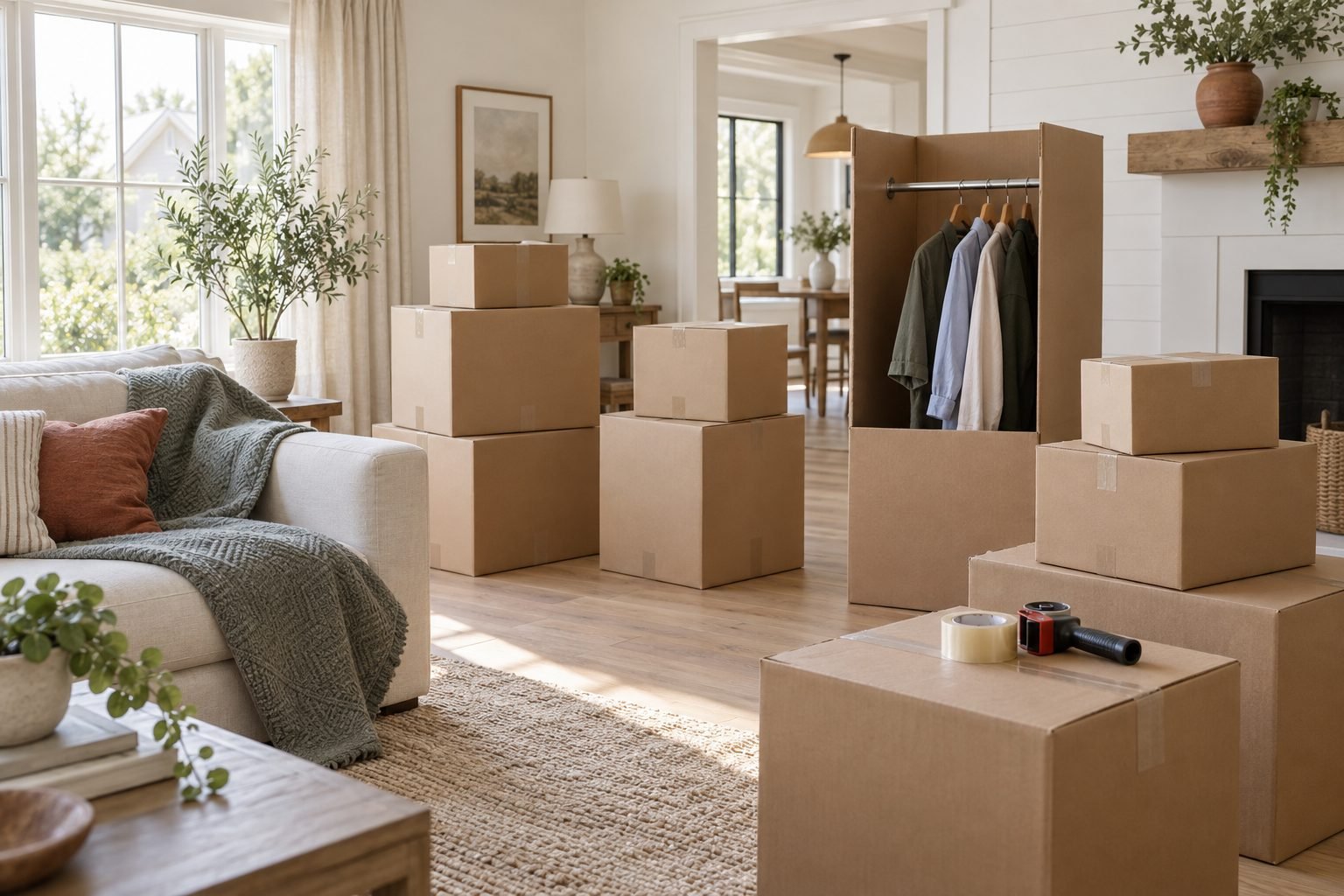
Most homes need somewhere between 20 and 160 boxes, depending on the number of rooms and how much is in them. The moving supply guide at Moving Place gives these ranges for an average move, and our moving box calculator lands inside them for each home size:
| Home size | Average move (Moving Place) | Our calculator, average stuff |
|---|---|---|
| Studio | 20–30 boxes | 25 boxes |
| 1-bedroom apartment | 30–40 boxes | 37 boxes |
| 2-bedroom apartment | 50–60 boxes | 50 boxes |
| 3-bedroom house | 80–100 boxes | 83 boxes |
| 4-bedroom house | 100–125 boxes | 114 boxes |
| 5+ bedroom house | 130–160 boxes | 136 boxes |
Light packers can need about a third fewer boxes, and homes with full closets, lots of books or a packed garage can need a third more. A quick rule from a packaging supplier quoted by Redfin is 10 to 15 boxes per room, and the same article cites a box seller’s advice to buy about 10 percent more than your estimate, so a few spare boxes are always on hand for the last-minute items.
Moving Box Sizes and What to Pack in Each
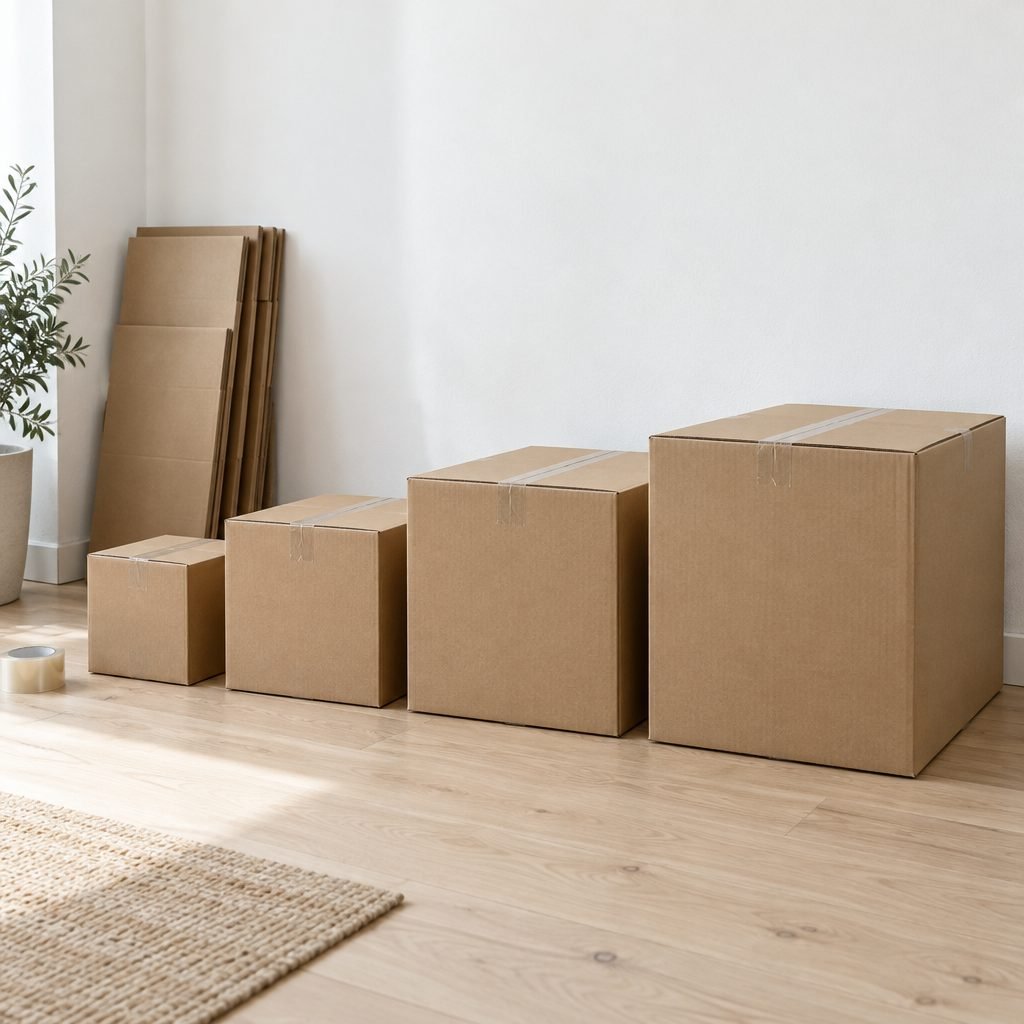
Pack heavy items in small boxes and light items in large ones. A large box full of books is too heavy to lift safely and can split, while a small box of pillows wastes space. These are typical sizes for standard US moving boxes:
| Box | Typical size | Volume | Best for |
|---|---|---|---|
| Small | 16.4 x 12.6 x 12.6 in (42 x 32 x 32 cm) | 1.5 cu ft | Books, dishes, canned food, tools |
| Medium | 18 x 18 x 16 in (46 x 46 x 41 cm) | 3 cu ft | Kitchen items, toys, decor, shoes |
| Large | 18 x 18 x 24 in (46 x 46 x 61 cm) | 4.5 cu ft | Bedding, towels, pillows, lampshades |
| Extra-large | 24 x 18 x 24 in (61 x 46 x 61 cm) | 6 cu ft | Comforters, cushions, light bulky items |
| Wardrobe | About 24 in (61 cm) wide | Varies | Clothes on hangers |
| Dish pack | 18 x 18 x 28 in (46 x 46 x 71 cm) | 5.25 cu ft | Plates, glasses, china |
The sizes come from U-Haul, which rates its small box for up to 65 lb (the box’s strength limit, not a comfortable lifting weight) and recommends it for books, tools and canned food. Its double-walled Dish Barrel box measures 18 x 18 x 28 in and is made for dishes, glassware and other fragile items, with a divider kit sold separately. Other stores sell slightly different sizes, so compare the dimensions rather than the names.
How Many Boxes per Room
Every room packs differently. Kitchens fill the most boxes for their size because of dishes, glasses and pantry food, while bathrooms need only a few. These are the average counts the moving box calculator uses before adjusting for how much you own:
| Room | Small | Medium | Large and XL | Specialty |
|---|---|---|---|---|
| Main bedroom | 3 | 4 | 4 | 2 wardrobe boxes |
| Other bedroom | 2 | 3 | 3 | 1 wardrobe box |
| Living room | 3 | 4 | 4 | – |
| Kitchen (2 bedrooms) | 5 | 5 | 2 | 2 dish packs |
| Dining room | 2 | 2 | 1 | 1 dish pack |
| Bathroom | 2 | 1 | – | – |
| Home office | 4 | 3 | 1 | – |
| Garage, basement or attic | 3 | 4 | 6 | – |
For hanging clothes, Moving Place suggests about one wardrobe box for every 2 feet (61 cm) of closet rail, and one or two dish packs per kitchen. Our own rule of thumb: if your garage, basement or attic is full, count it as two rooms. Our guide to decluttering your home helps you cut the pile before you pack.
Packing Supplies Checklist
Boxes are only half the shopping list. Buy these at the same time so packing day does not stop halfway:
- Packing tape. Wide 2 in (48 mm) tape and a tape gun. Plan on roughly one roll for every 15 boxes, because each box needs tape across the bottom and top seams.
- Packing paper. Plain newsprint for wrapping dishes and glasses. Newspaper ink can rub off on plates.
- Bubble wrap. One roll for lamps, frames, mirrors and electronics.
- Markers and labels. Write the room and a short list of contents on two sides of every box, not the top, so you can read them when boxes are stacked.
- Furniture pads or blankets. To protect furniture, mirrors and floors on moving day.

Save the calculator
Pin it so the box list is on your phone when you shop for boxes and supplies.
Save to PinterestHow to Use Fewer Moving Boxes
- Declutter first. Every item you donate is one you do not have to wrap, carry and unpack. Start with closets using our closet clean-out checklist.
- Pack soft things in what you already own. Suitcases, duffel bags and laundry baskets hold clothes, towels and bedding.
- Leave light items in drawers. Many movers let you leave clothes in dresser drawers if the dresser is not too heavy to carry. Ask your mover first.
- Use wardrobe boxes for hanging clothes. They hold clothes on their hangers, so you skip folding and the closet is ready to fill on day one.
- Eat down the pantry and freezer. Plan meals for the last two weeks so there is less food to pack.
Once you arrive, unpack the kitchen and bedrooms first. Our guides on how to organize kitchen cabinets and small closet organization ideas help you set up the new place, and our storage ideas for small spaces are useful if you are moving somewhere smaller.
Putting some of it into storage? Our storage unit size calculator tells you which unit size fits your boxes and furniture.
Moving Box FAQ
How many boxes do I need for a 1-bedroom apartment?
Plan on about 30 to 40 boxes for an average 1-bedroom apartment, or 20 to 30 if you own very little. That is usually around 12 small, 13 medium, 9 large or extra-large, 2 wardrobe boxes and 1 dish pack.
How many boxes do I need for a 2-bedroom apartment?
An average 2-bedroom apartment needs about 50 to 60 boxes. Light packers can manage with about 40, and a home with lots of books, toys or a storage unit can need 65 to 75.
How many boxes do I need for a 3-bedroom house?
A 3-bedroom house with a garage typically needs about 80 to 100 boxes. Garages, basements and attics vary the most, so look inside them before you buy.
How many wardrobe boxes do I need?
A common rule of thumb from Moving Place is about one wardrobe box for every 2 feet (61 cm) of closet rail. Fold what you can into regular boxes and keep wardrobe boxes for shirts, dresses and coats that crease.
Where can I get moving boxes?
You can buy new boxes from moving truck rental companies, home improvement stores and online, or look for used boxes through local buy-and-sell groups and neighbors who just moved. Check used boxes for damp, crushed corners and pests before you pack them.
More Planning Tools
Planning the new place? Try our curtain size calculator for new windows, the washer and dryer space calculator to check that your machines fit, and the shelf spacing calculator for closets and pantries.
How this tool was made: built with the help of AI tools, tested in the browser and published by Mohamed Elber. Results are planning estimates based on box-count ranges published by moving supply companies; box sizes vary by store. Images are AI-generated illustrations. See our Editorial Policy.