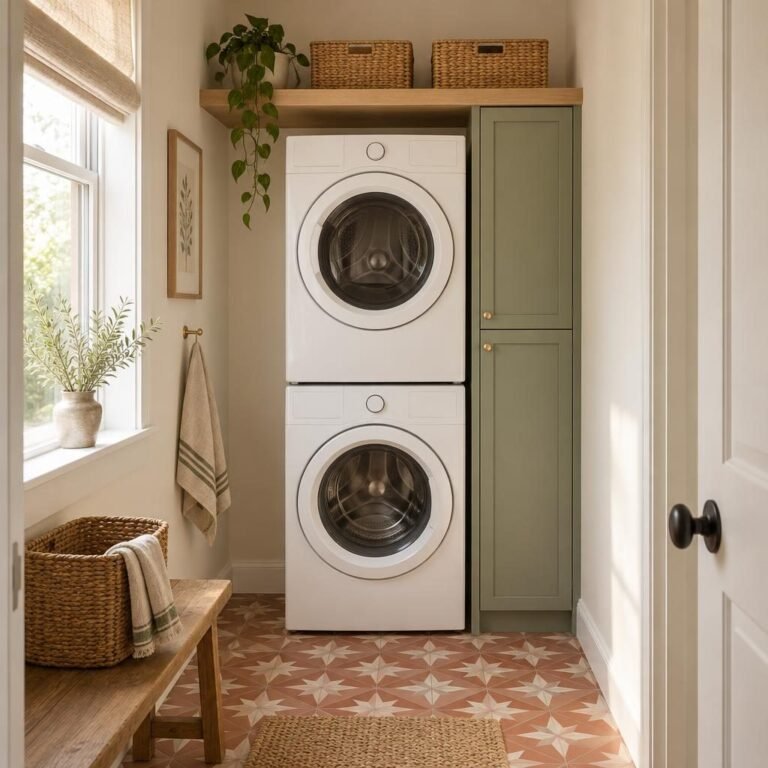
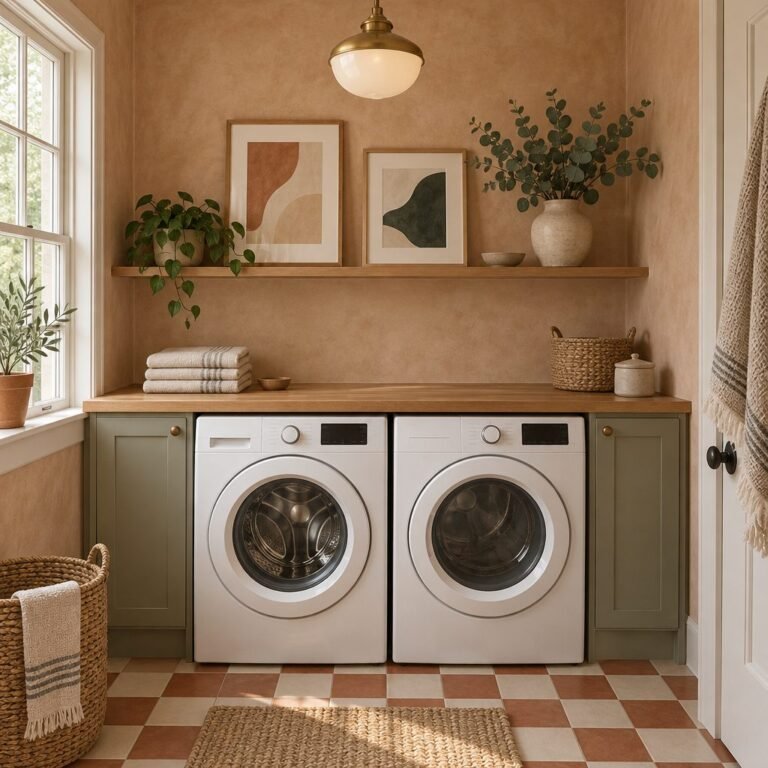
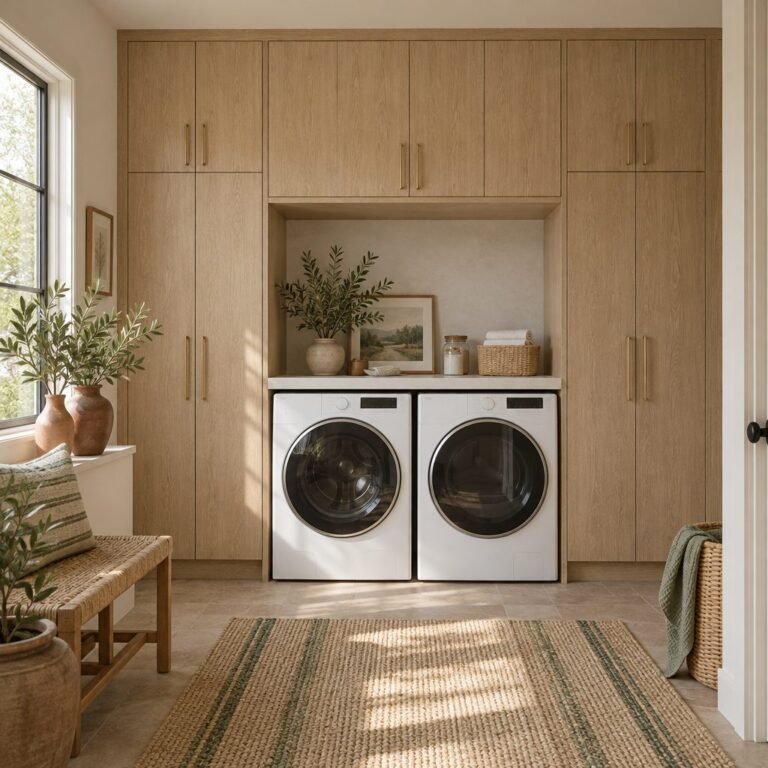
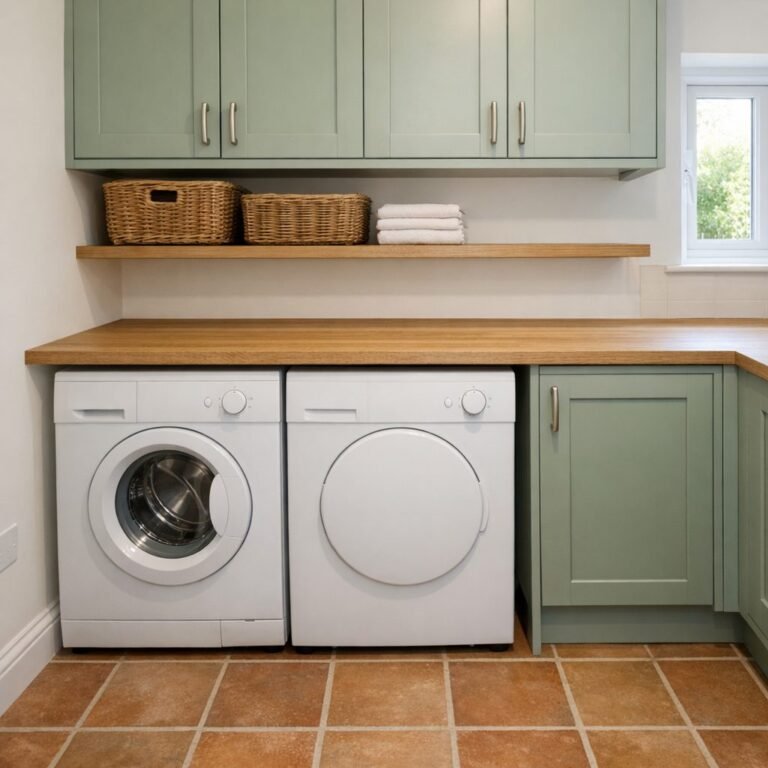
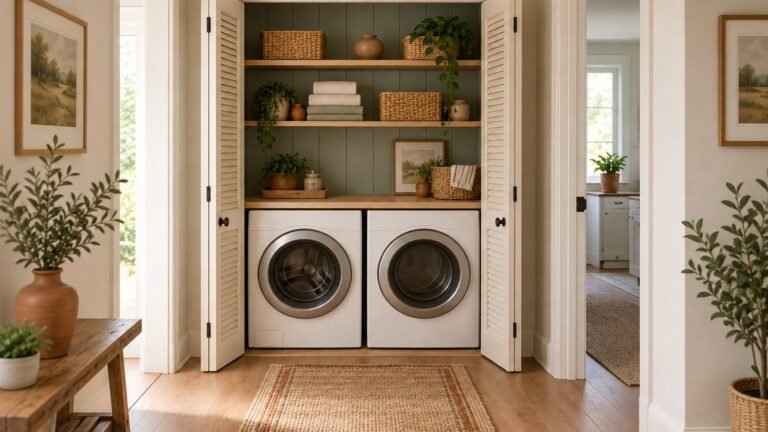
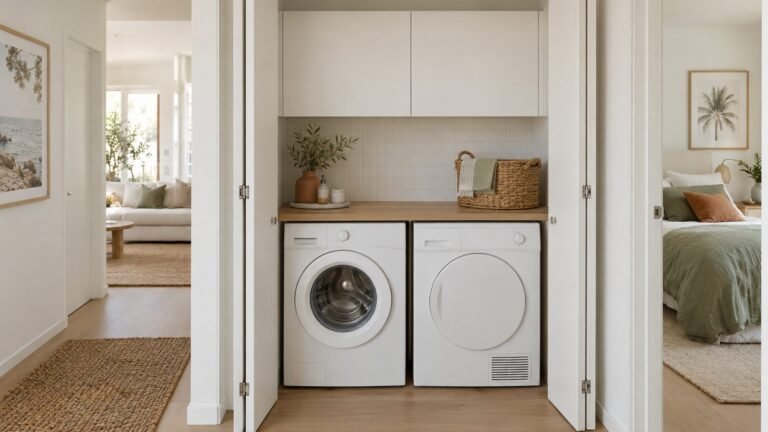
Most small laundry room ideas assume you have a front-loading washer. They show countertops, cabinets and stacked machines, none of which work when your washer opens from the top.
A top-loader changes the rules: the lid needs open space above it, and anything you store on top of the machine has to move every time you do a load. This guide shows you how to plan around that, with a simple clearance guide and 15 small laundry room ideas that actually work with a top loading washer.
Key Takeaways
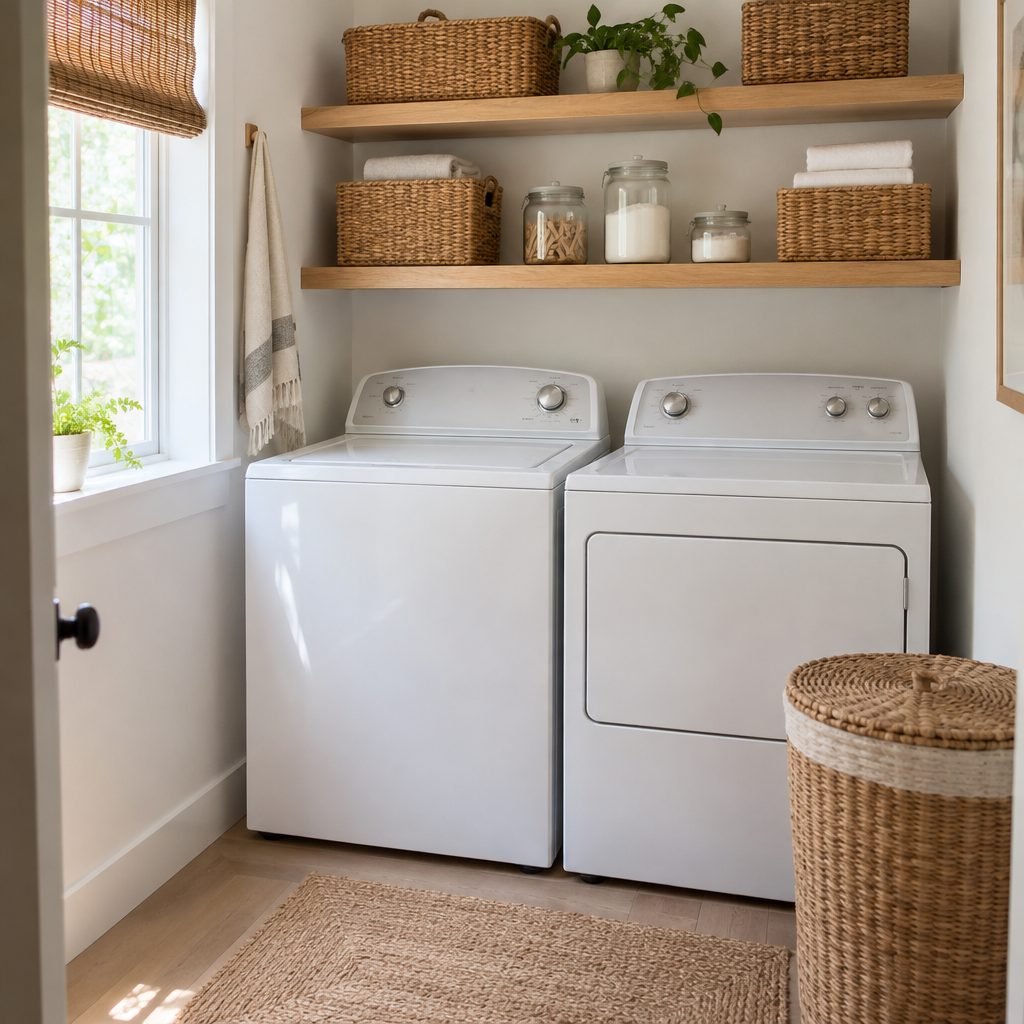
- Quick answer: The best small laundry room ideas with a top loading washer keep the lid clear: hang shelves above the fully open lid plus a few inches, and use the gaps beside the machines, the walls and the door for storage.
- Leave enough clearance so the washer lid can open fully under any shelf.
- Use the gaps beside the machines, the walls and the space above for storage.
- Keep detergent pods and chemicals out of children’s reach.
Time: 1–3 hours · Cost: $20–100 · Difficulty: Easy
The Top-Loader Rule: Keep the Space Above the Lid Clear
With a front-loader, the space above the machine is free real estate. With a top-loader, it’s a no-storage zone up to the height of the open lid. Put a shelf, cabinet or countertop too low and the lid won’t open fully, which makes loading and unloading a daily annoyance.
Once you know that height, everything above it is usable storage, and everything beside and around the machines becomes your main organizing space.
How to Plan a Small Laundry Room Around a Top-Loader
- Measure with the lid open. Record measurements A and B from the guide above, plus the width of each gap beside and between your machines.
- Mark the no-storage zone. Use painter’s tape on the wall to mark the lowest safe shelf height, so you can see it before you drill.
- Decide what lives where. Daily supplies go beside the machines, backups go on high shelves, and the walls handle drying and hanging.
- Keep the lid clear. Plan a home for everything that currently sits on top of the washer.
15 Small Laundry Room Ideas With a Top Loading Washer
Above the Machines
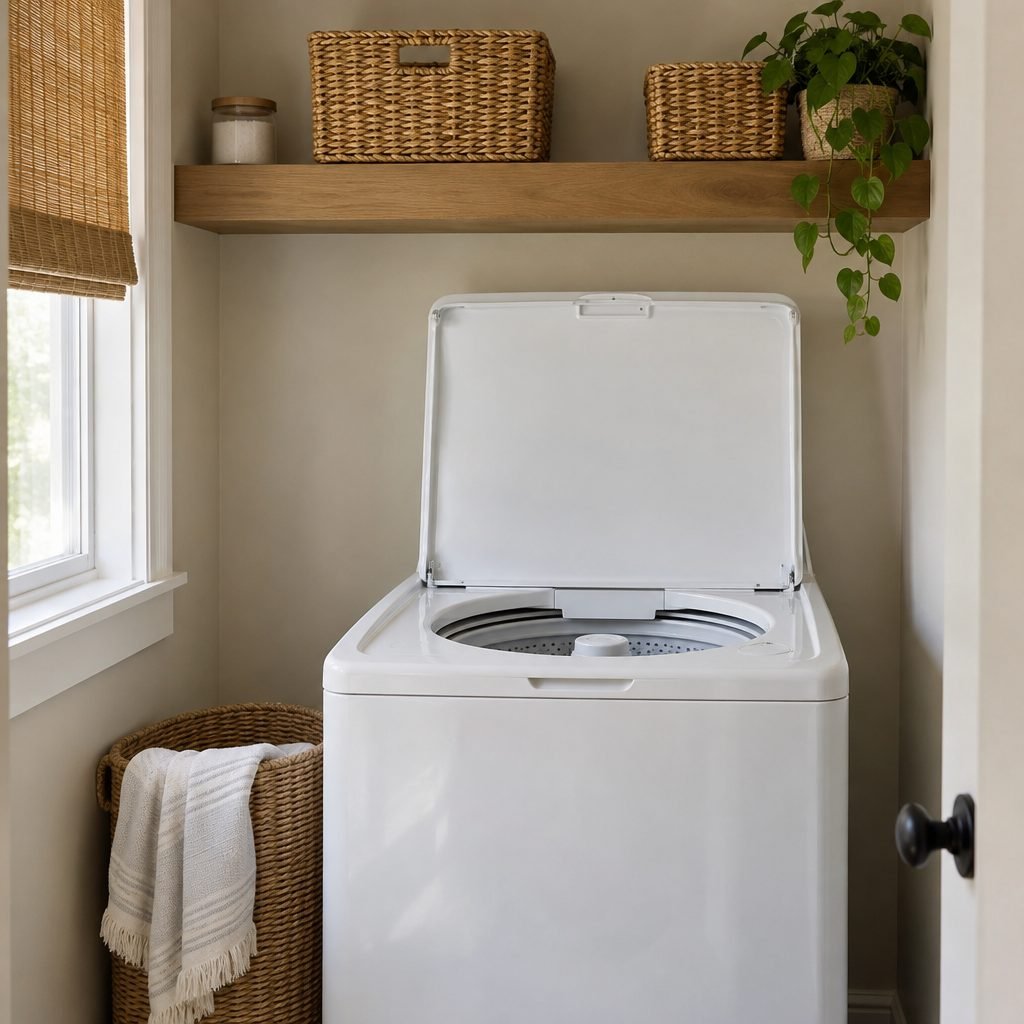
1. Hang floating shelves above the lid line. Mount open shelves just above your lowest safe height. Use them for backups, extra towels and things you don’t need every load, stored in baskets so they’re easy to pull down.
2. Choose shallow shelves. A shallow shelf is easier to reach over a top-loader and less likely to get in the way of the lid. Deep shelves above a washer tend to collect things you can’t reach.
3. Use the space above the dryer differently. If your dryer opens from the front, the space above it doesn’t have the same lid problem. A shelf or small folding surface above the dryer only can give you a work area while the washer lid stays free.
4. Keep nothing on the washer lid. Bottles and baskets on the lid have to be moved for every load, and small items can fall into the drum. Give each one a home somewhere else.
Beside and Between
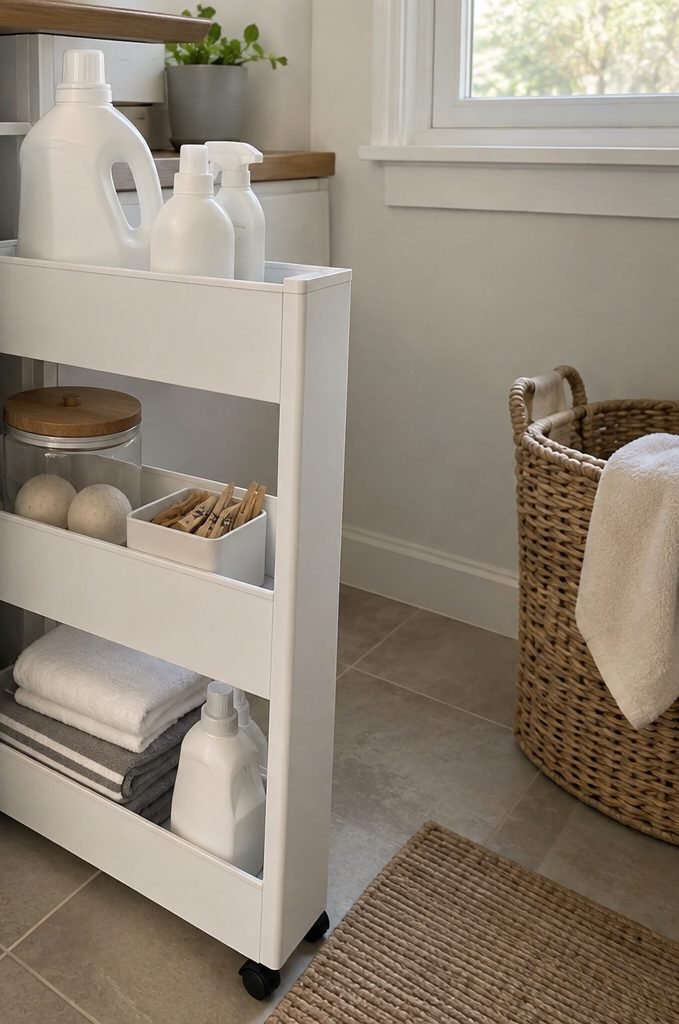
5. Slide a slim rolling cart into the gap. The narrow space beside a washer or between the machines and the wall is perfect for a slim rolling cart. It holds detergent, dryer balls and clothespins, then rolls out when you need them.
6. Add a narrow shelf unit at the side. If you have a few more inches, a tall narrow shelving unit beside the machines holds far more than a cart and keeps supplies at arm’s height.
7. Store detergent where kids can’t reach. If you use liquid laundry packets, the U.S. Consumer Product Safety Commission recommends keeping them sealed in their original packaging and locked up out of a child’s sight and reach. A high shelf or a latched cabinet beside the machines works well.
Walls and Doors
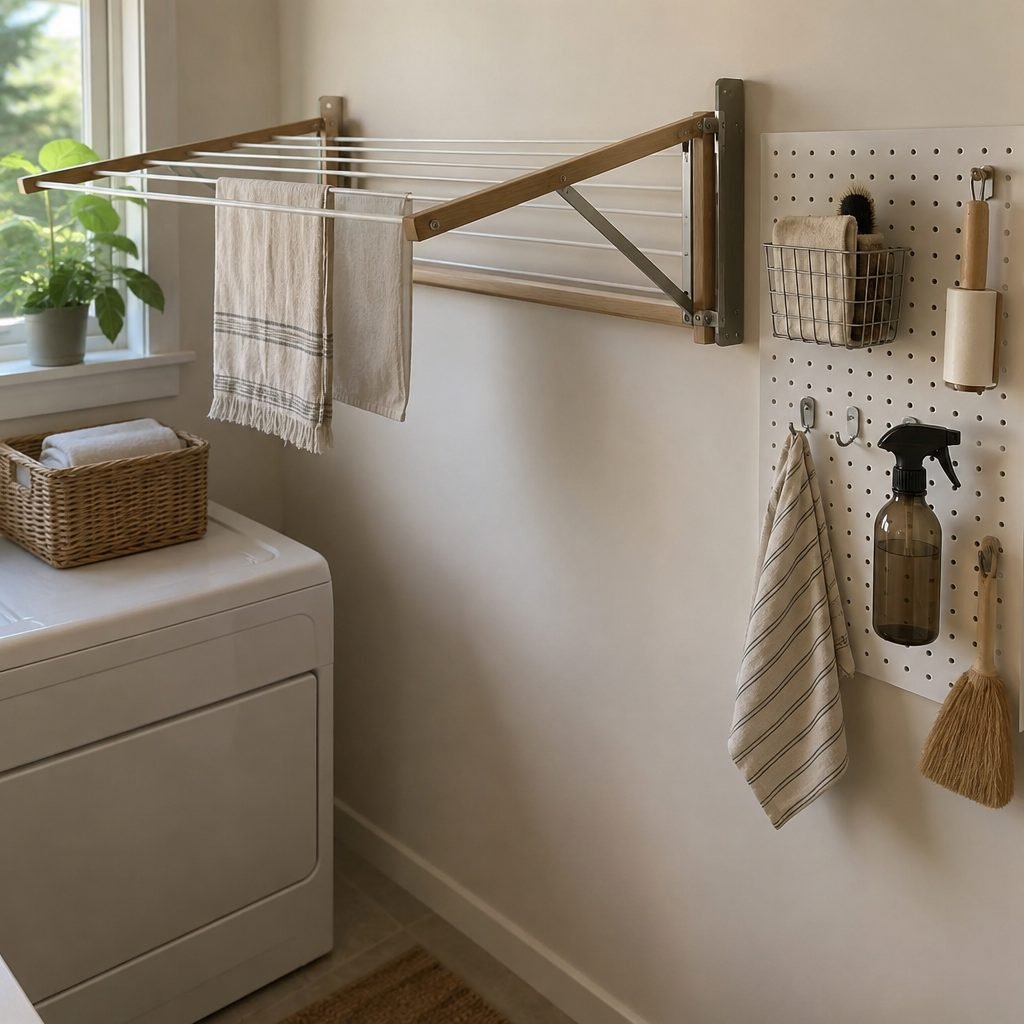
8. Install a fold-down drying rack. A wall-mounted drying rack folds flat when you don’t need it and gives you hanging space for delicates when you do, without taking any floor space.
9. Use a pegboard for small tools. A pegboard holds a lint roller, a stain brush, a small basket and a spray bottle, and it’s easy to rearrange as your needs change.
10. Add hooks for hanging clothes. A row of hooks or a short wall rod lets you hang shirts straight out of the dryer, so fewer things end up in a wrinkled pile.
11. Put the back of the door to work. An over-the-door organizer holds cleaning cloths, dryer sheets and stain sprays in a spot that’s usually wasted. The same trick works in small bathrooms, as in our over the toilet storage ideas.
Laundry Closets and Floor Space
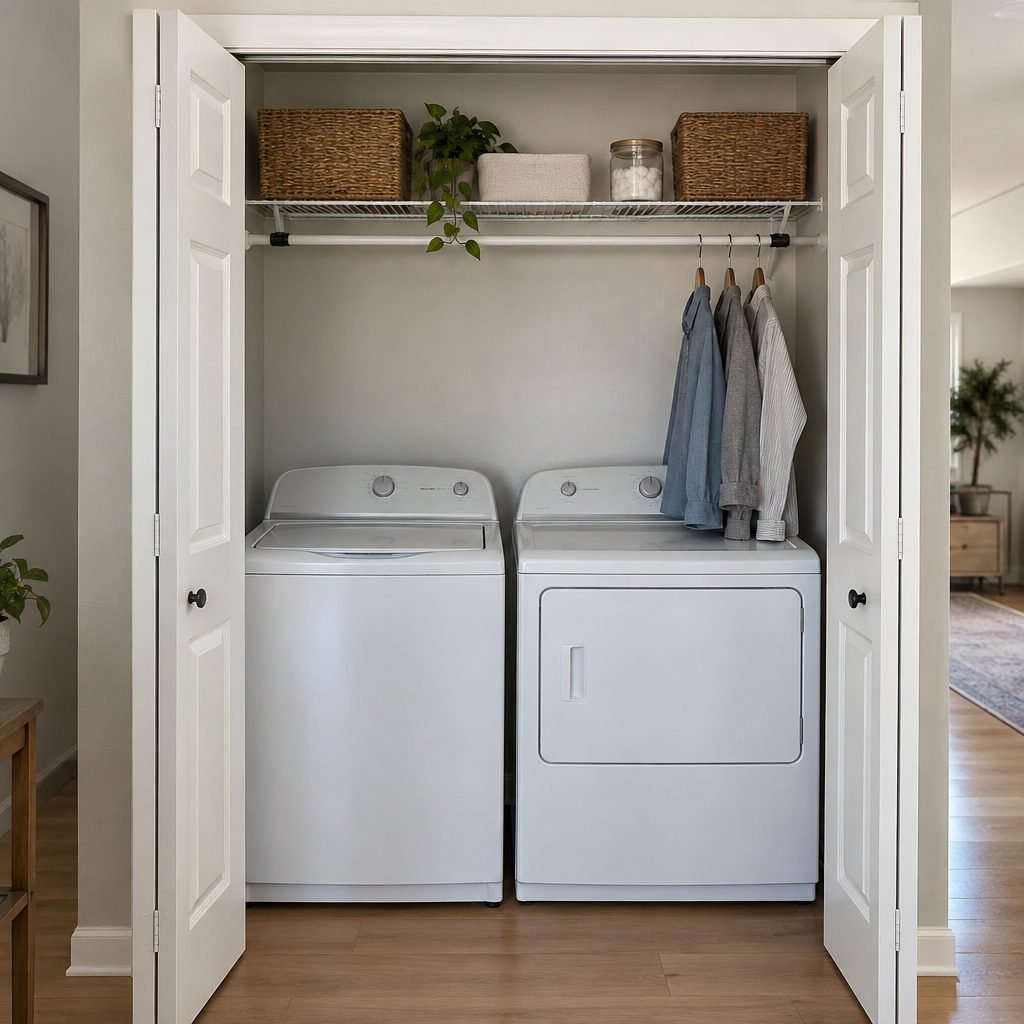
12. Hang a tension rod in a laundry closet. In a laundry closet, a tension rod above the dryer side gives you instant hanging space without drilling. Keep it above the washer’s lid line on the washer side.
13. Use stackable or tall narrow hampers. Sorting hampers that stack or stand tall take less floor space than wide baskets. Label them lights, darks and towels to cut sorting time.
14. Add a fold-down wall table. If you don’t have a counter, a small fold-down table on the wall gives you a folding surface that disappears when you’re done.
15. Keep the dryer area clear. Don’t store baskets or supplies against the back of the dryer. The U.S. Fire Administration recommends cleaning the lint filter before and after each cycle and checking that the vent behind the dryer isn’t crushed or restricted.
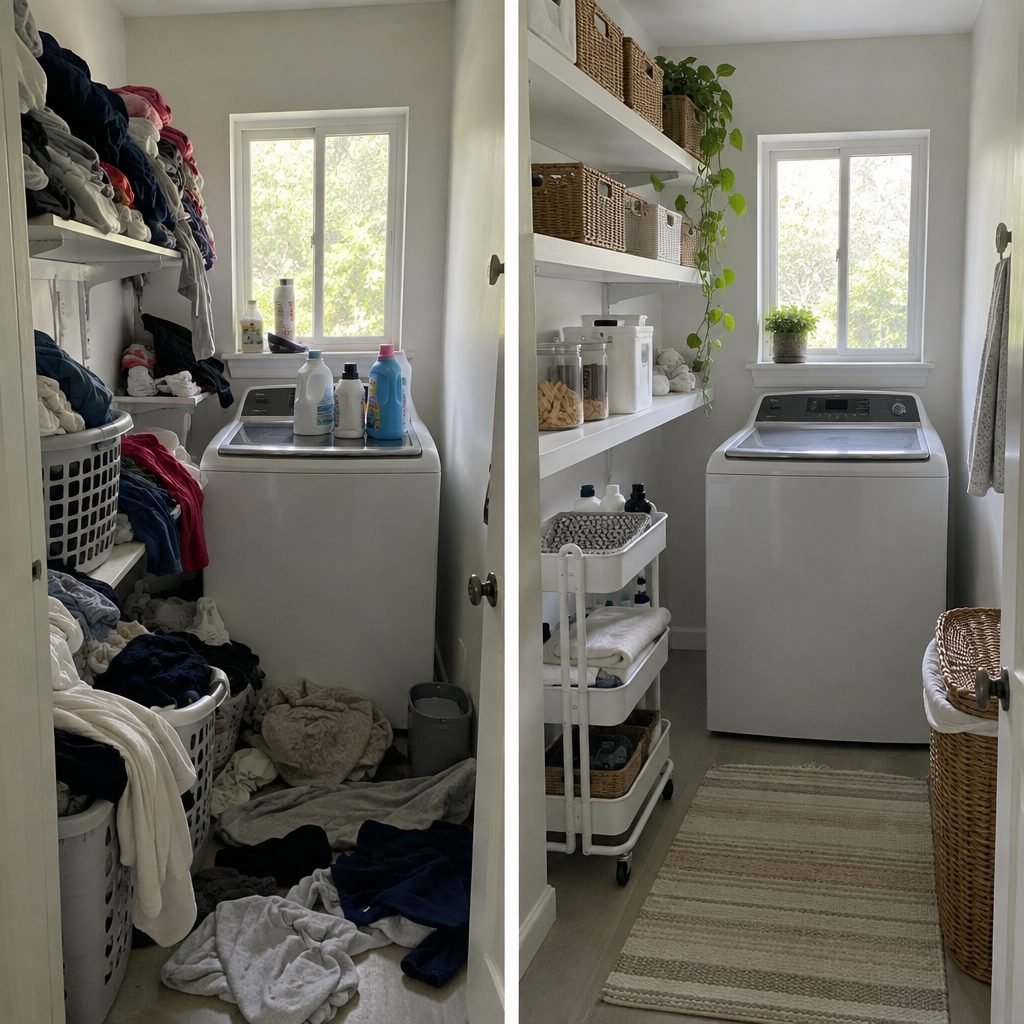
Common Mistakes in Small Laundry Rooms With a Top-Loader
- Hanging shelves before measuring the open lid. Measure first, drill second.
- Using the washer lid as a shelf. Everything on it has to move for every load.
- Buying a countertop meant for front-loaders. A counter over a top-loader blocks the lid unless it’s hinged or removable.
- Blocking the dryer vent. Keep the space behind and around the dryer free of storage.
- Keeping too much. A small laundry room works best with one of each supply in use and a small backup stash, not a whole shelf of half-used bottles. The same clean-out approach we use for closets works here too.
Small Laundry Room With a Top-Loader FAQ
Can you put a shelf above a top loading washer?
Yes, as long as the bottom of the shelf sits above the height of the fully open lid, plus a few inches of hand room. Measure with the lid open before you install anything.
How high should a shelf be above a top loader?
Add the height of the closed washer to how far the lid rises when open, then add a few inches so you can reach in comfortably. That total is the lowest safe height for the bottom of the shelf. Check your washer’s spec sheet for its height with the lid open.
Can you put a countertop over a top-loading washer?
Not a fixed one, because it would block the lid. You can add a folding surface above the dryer only, use a fold-down wall table, or choose a hinged or removable top made for this purpose.
How do I make a small laundry room more functional?
Keep the lid clear, move daily supplies to a slim cart beside the machines, put backups on high shelves, and use the walls for drying and hanging. Getting things off the floor makes the biggest difference.
Planning a full makeover or working with front-loaders instead? Our main guide to small laundry room ideas covers 20 layout, storage and design ideas for every type of washer and dryer.
Planning around a top-loader? Our free washer and dryer space calculator checks the width, depth and lid clearance your space needs.
Planning a laundry closet instead of a full room? See our laundry closet ideas for door options, closet sizes and storage that works around stacked or side-by-side machines.
Final Thoughts
A top-loading washer doesn’t mean giving up on storage. It just means working with the lid instead of against it: measure the open-lid height, keep that space clear, and use the gaps, walls and high shelves for everything else.
For the rest of the room, from sorting to folding, see our step-by-step guide on how to organize a laundry room. Save this guide to Pinterest so you have the clearance guide handy before you hang your first shelf.
How this guide was made: researched and written with the help of AI tools, fact-checked against trusted sources and published by Mohamed Elber. Images are AI-generated illustrations. See our Editorial Policy.