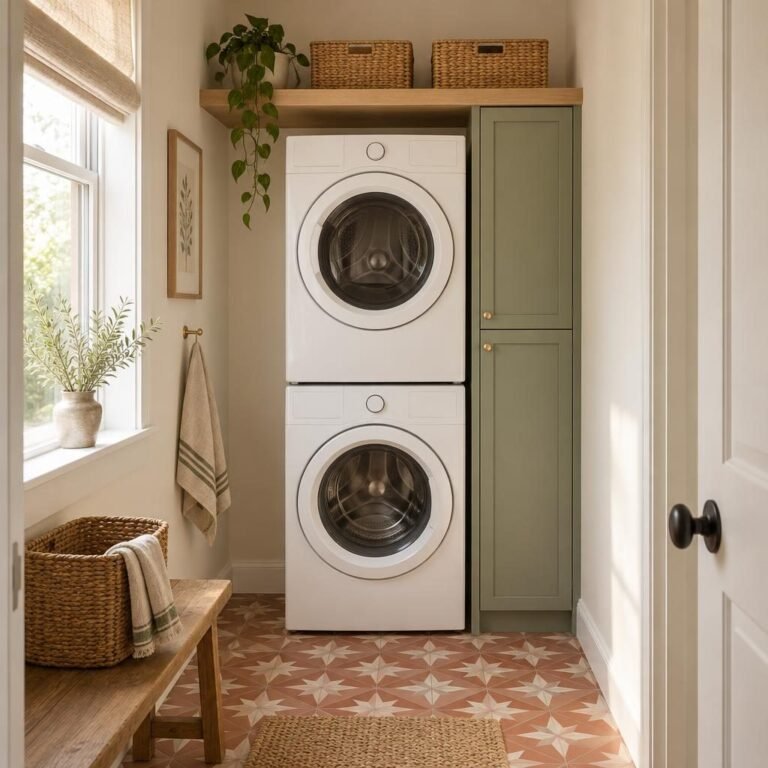
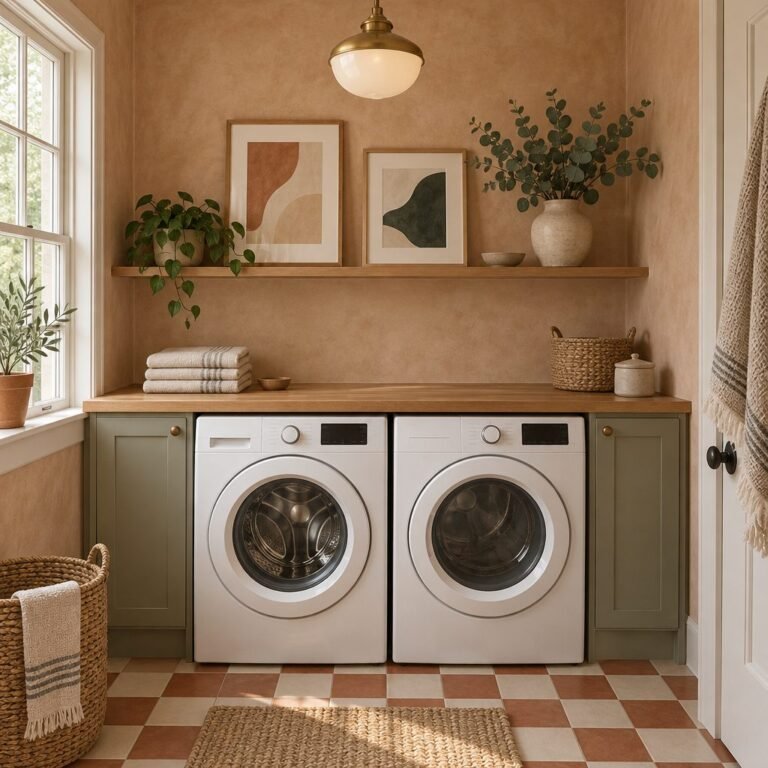
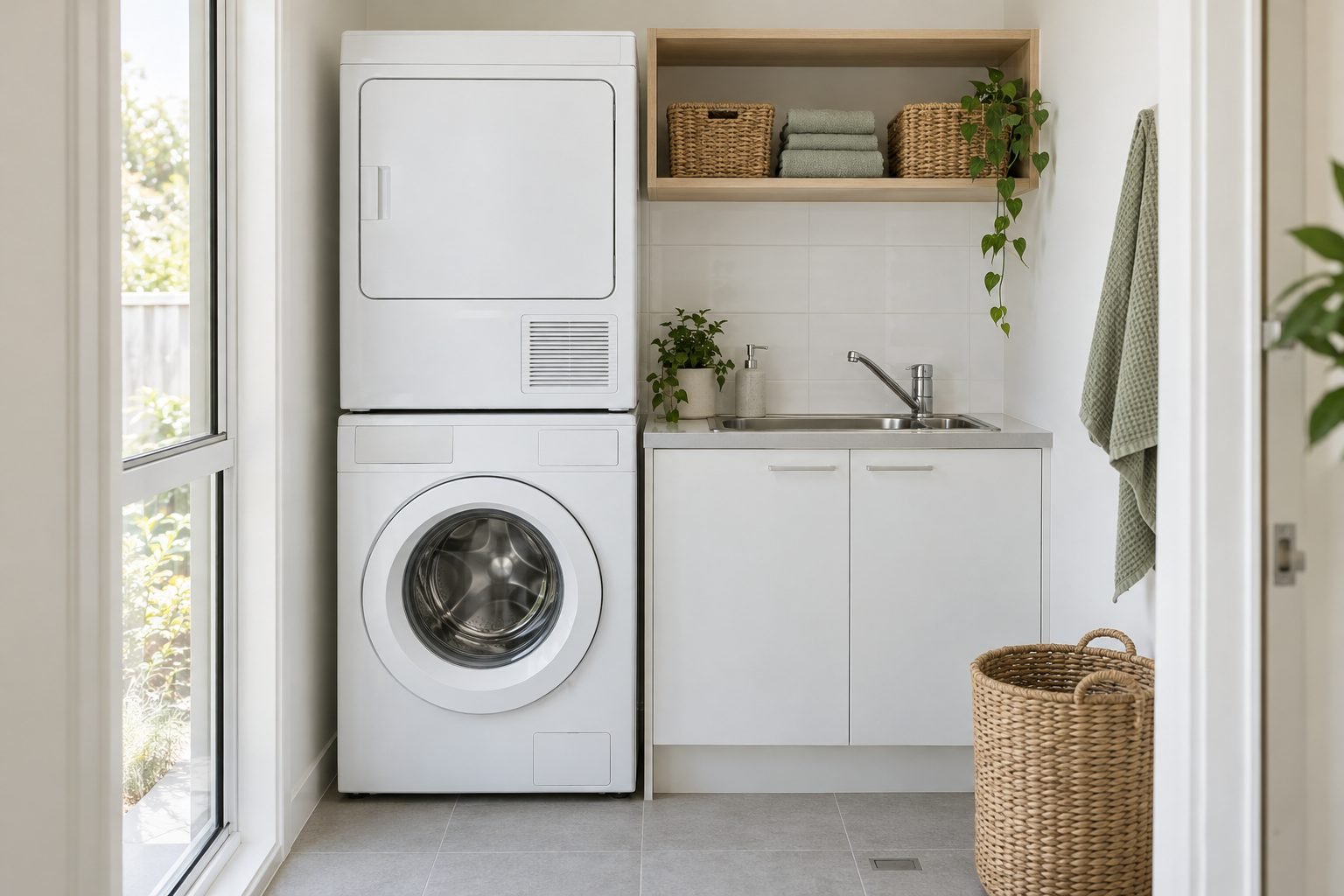
Small laundry ideas work best when you plan in millimetres first and decorate second. In Australia the National Construction Code doesn’t set a minimum laundry size, but for houses it does require at least one washtub and space in the same room for a washing machine, so even the tiniest laundry needs room for both. A stacked washer and dryer beside a standard 45-litre tub cabinet can fit on about 1.15 m of wall.
This guide takes you through a small laundry in seven steps: measuring, choosing a layout for your size, picking appliances, fitting a tub and benchtop, adding storage, checking the rules and storing chemicals safely. If your laundry hides in a cupboard, see our European laundry ideas; for more styling ideas, see our small laundry room ideas.
Step 1: Measure the Space and Find the Services
Measure the length of the wall you can use, the depth from that wall to the doorway or opposite wall, and the ceiling height if you want to stack. Then mark where the cold and hot taps, the drain and the powerpoint are: moving them can be costly, so plan around them where you can. Note which way the laundry door swings and whether it will hit an open machine door.
Write down the size of the machines you already own, or plan to buy, before you look at cabinets. Our washer and dryer space calculator checks whether they will fit in the gap you have.
Step 2: Choose the Layout That Fits Your Size
Most small Australian laundries fall into one of three plans. The diagram shows each one from above with typical sizes, and the table below adds two common alternatives.
| Layout | Best for | Wall run (approx.) | Depth to plan for* |
|---|---|---|---|
| Single wall, stacked machines + tub | Laundries of about 1.8 m² | 1,150 mm | 1,550 mm (650 + 900) |
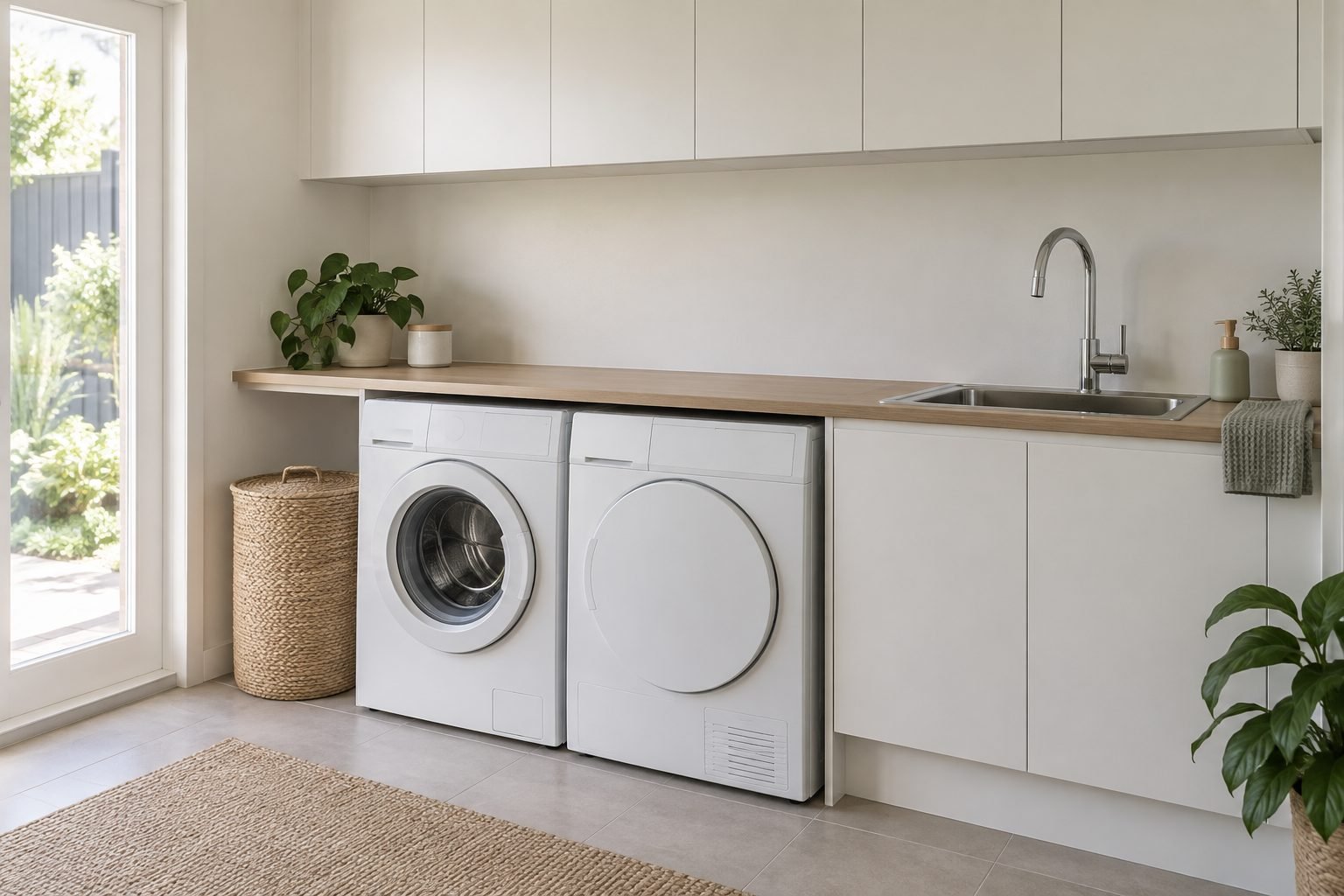
| Side by side under a benchtop | A wider alcove or room | 1,750 mm | 1,550 mm |
| Galley with shelves opposite | Narrow walk-through laundries | 1,150 mm or more | 1,900 mm (650 + 900 + 350) |
| Laundry in the bathroom | Homes with no separate laundry | Washer + its own tub | Shared floor space |
| Garage or carport corner | Older homes and units | Any | Vent a vented dryer outside |
*Our planning guide, worked out from typical appliance sizes: allow about 625 mm of width per machine, 499 mm for a 45 L tub cabinet, 650 mm of depth for the machines (add up to 150 mm for hoses if your installation guide asks for it) and about 900 mm of standing room in front. These are not building rules, so measure your own appliances.
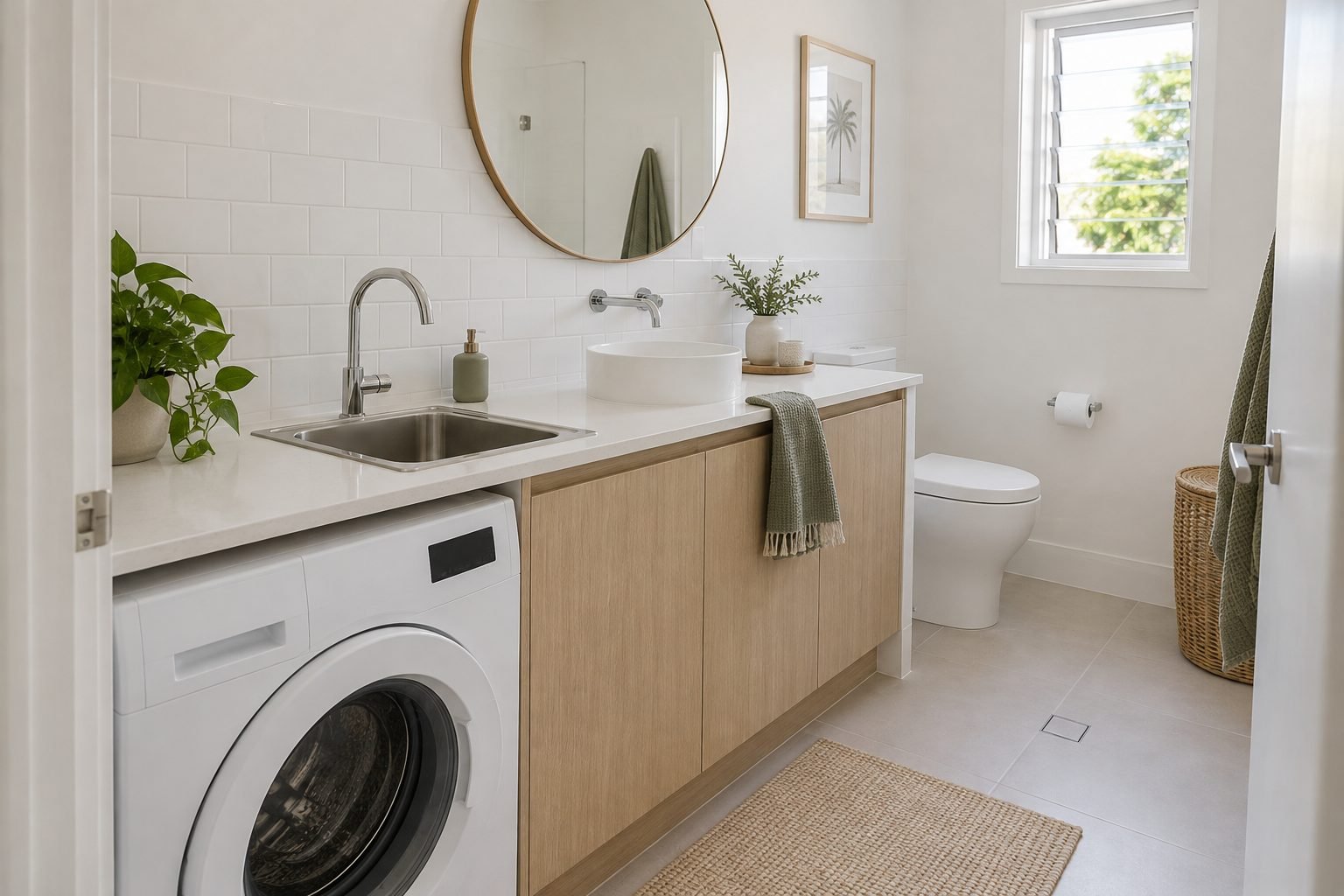
A laundry can also share a room. South Australia’s 2018 building advisory notice says laundry facilities are permitted in a bathroom or kitchen, but where the washing machine sits there, that area must also have a laundry tub: a basin or kitchen sink doesn’t count. In a hallway or bathroom, our laundry closet ideas show how to close it off neatly.
Step 3: Pick Appliances That Fit
Most full-size machines are 600 mm wide. A 7.5 kg Fisher & Paykel front loader, for example, is 850mm high, 600mm wide and 590mm deep, while Fisher & Paykel’s 8 kg heat pump dryer (DH8060P1) is 645 mm deep and the retailer recommends allowing an extra 150mm in depth for hoses and connections. Front loaders can be stacked with the dryer on a stacking kit made for your models; top loaders can’t, because the lid opens upwards.
Remember the doors. Haier’s planning guide gives an overall depth of 1,062 mm for one of its washer dryers with the door open, and a minimum cavity width of 625 mm. A combined washer dryer is the smallest option of all: one 600 mm machine that washes and dries.
In a closed or windowless laundry, a heat pump dryer is the easiest choice. Energy Rating says vented dryers pump hot, humid air into the surrounding space, while heat pump dryers are much more energy efficient because they capture and reuse their heat.
Step 4: Fit a Tub and a Benchtop
The tub is the part people try to skip in a tiny laundry, but the NCC requires one in a new house (apartments may share a communal laundry). A standard 45-litre tub cabinet is 499mm wide, and Bunnings lists slimmer options, including a 16-litre mini tub at just 300mm wide and a 310 mm-wide 25-litre square sink. A tub set flush into a benchtop over the machines gives you a folding surface and a single easy-to-wipe top.
Leave the clearance your machine’s installation guide specifies under the benchtop (Haier lists a minimum cavity height of 865 mm for its 850–865 mm washer dryer), and keep wall cabinets high enough that you can lean over the tub without hitting your head.
Step 5: Go Vertical With Storage
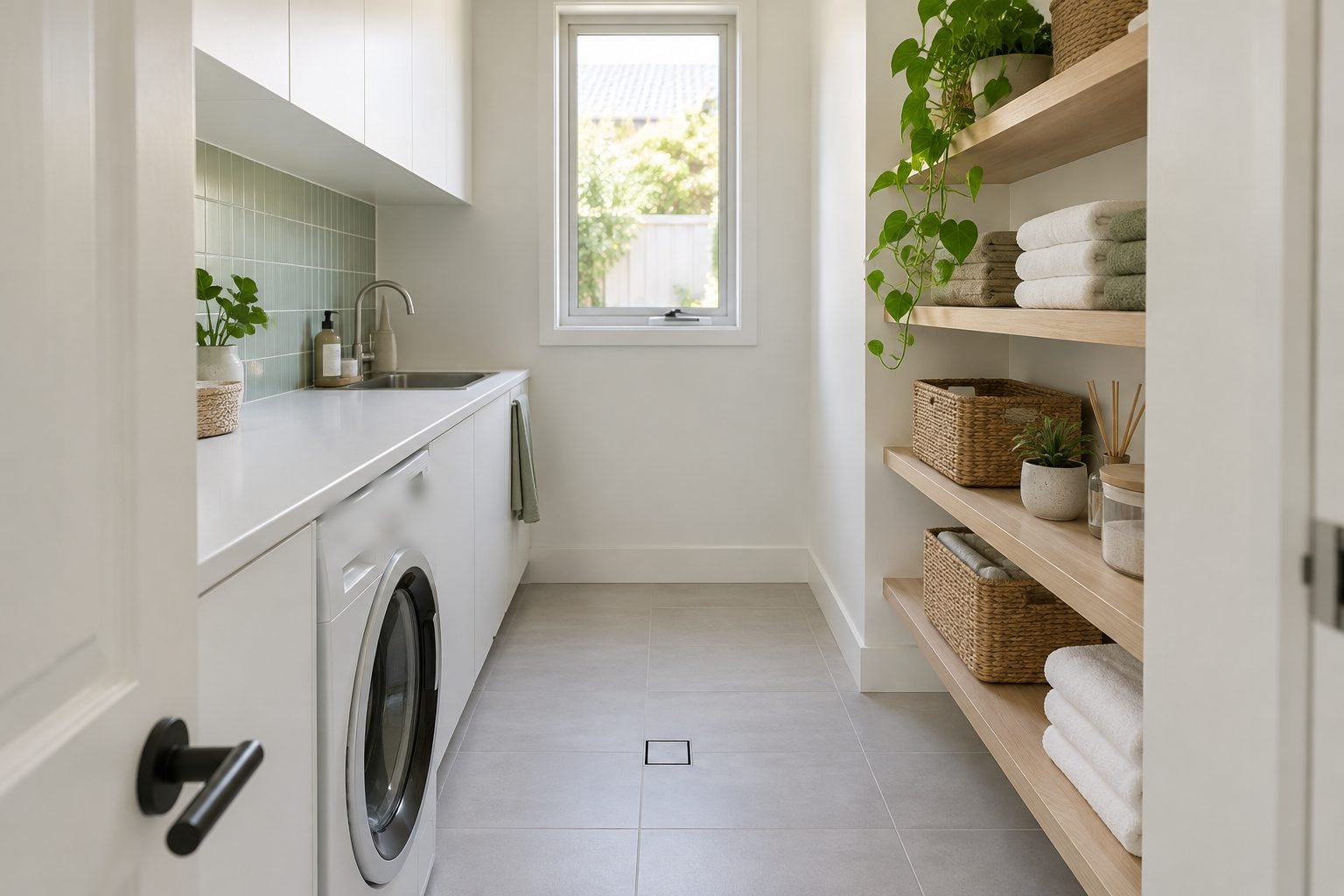
Floor space is what a small laundry lacks, so build up. Overhead cupboards hold refills and spare towels, a slim pull-out between the machines or beside the tub holds bottles, and a short hanging rail under the cupboards lets shirts dry on hangers. In a galley laundry, shallow open shelves of about 350 mm on the opposite wall keep the walkway clear. Our laundry cabinet ideas and guide to organising a laundry show what goes where; if towels overflow, move them to the linen cupboard.
Step 6: Check the Rules and Book the Trades
Laundries are wet areas. Under the NCC Housing Provisions, the floor of the room must be water resistant, the wall/floor junctions must be water resistant, and the wall behind the washing machine must be water resistant from the floor to at least 75 mm above and 75 mm each side of the tap outlets. If the laundry has a floor waste, the floor, wall/floor junction and penetrations must be waterproof.
Under NCC Part 10.8, a vented dryer must discharge to outdoor air, directly or via a duct; condenser and heat pump dryers don’t need a duct. New taps, drains and waste pipes are jobs for a licensed plumber: in Victoria, the building authority reported that six people, including some working without a registration or licence, were fined a combined $44,855. Moving or adding powerpoints needs a licensed electrician, and Ausgrid warns that DIY electrical is not only dangerous, it’s illegal.
As a rough budget, Three Birds Renovations puts a budget or cosmetic laundry renovation at about $5,000 – $10,000, with mid-range jobs at $10,000 to $18,000 (July 2025). Prices vary by state and by how much plumbing moves, so get several quotes.
Step 7: Store Chemicals Safely
Detergents and capsules are a real risk for children in a small laundry where everything is within reach. NSW children’s health advice is to store poisons at least 1.5 metres off the ground in a child-resistant locked cupboard, in their original containers. The ACCC says to store laundry capsules up high, out of reach and sight of children. If anything is swallowed, call the Poisons Information Centre on 13 11 26; if your child collapses or stops breathing, call 000.
If your laundry is in the garage or by the back door, a bench, hooks and a boot tray can turn it into a drop zone too: see our mudroom ideas, or for a back-of-house utility space, our small utility room ideas.
Small Laundry FAQ
What is the minimum size for a laundry in Australia?
The NCC sets no minimum room size, but for houses it does require at least one washtub and space in the same room for a washing machine. A washer in a 625 mm space next to a 499 mm tub cabinet needs about 1.15 m of wall, plus roughly 900 mm of standing room in front.
Can a laundry go in a bathroom?
Yes. South Australia’s advisory notice says laundry facilities are permitted in a bathroom or kitchen. A washbasin doesn’t count as the laundry tub, so if the washing machine goes in the bathroom, a separate tub is needed there too. Moving water or waste pipes is work for a licensed plumber.
What should you not store in the laundry?
Don’t keep detergents, capsules or chemicals at child height. NSW children’s health advice is to store poisons at least 1.5 metres off the ground in a child-resistant locked cupboard, in their original containers. If anything is swallowed, call the Poisons Information Centre on 13 11 26; if your child collapses or stops breathing, call 000.
Do I need to vent a dryer in a small laundry?
Only if it is a vented dryer. The NCC (Part 10.8) requires a vented dryer to discharge directly or via a duct to outdoor air; condenser and heat pump dryers don’t need a duct. Energy Rating says heat pump models are much more energy efficient, which suits closed, windowless laundries.
How this guide was made: researched and written with the help of AI tools, fact-checked against trusted sources and published by Mohamed Elber. Images are AI-generated illustrations. See our Editorial Policy.