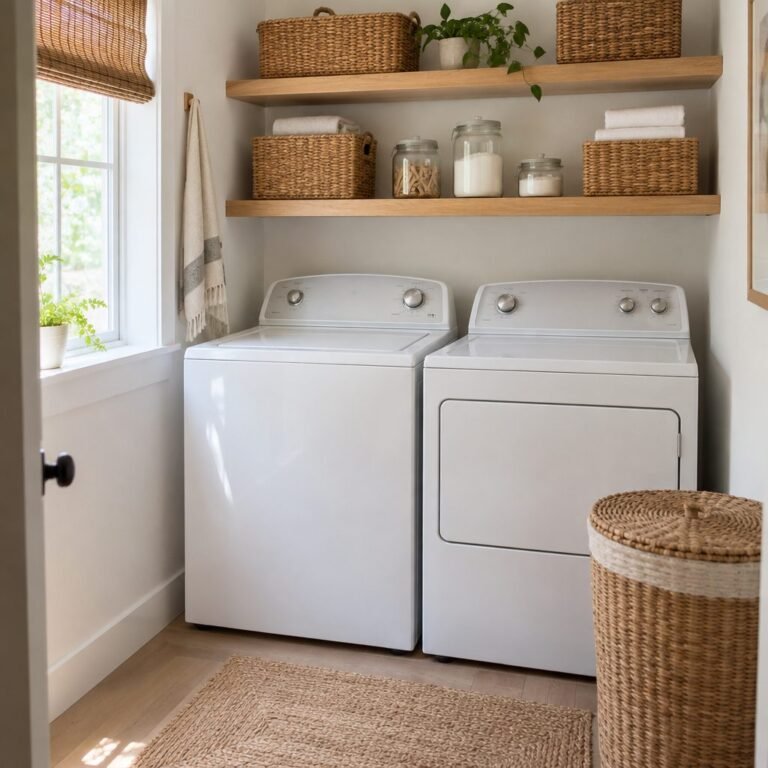
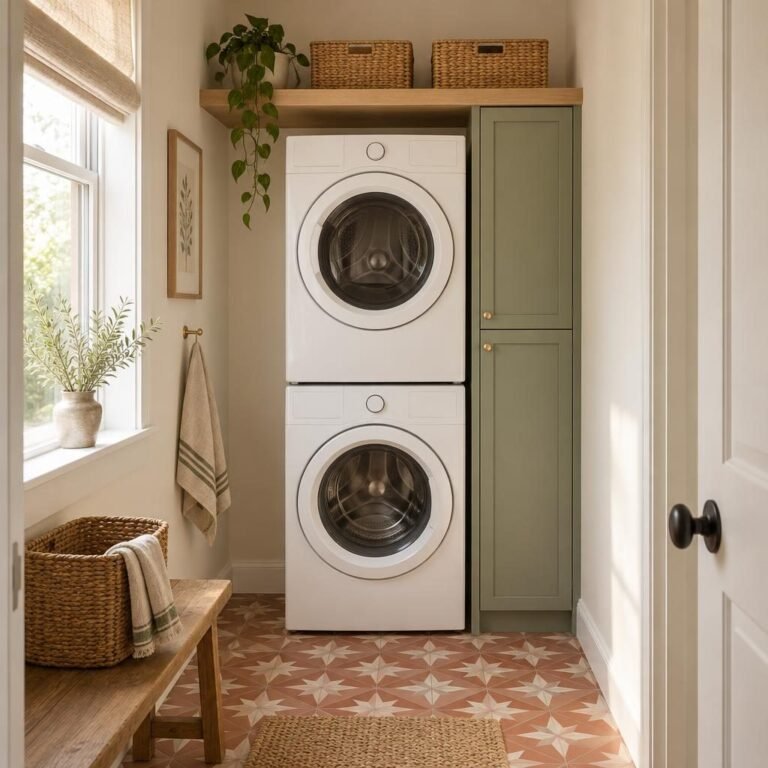
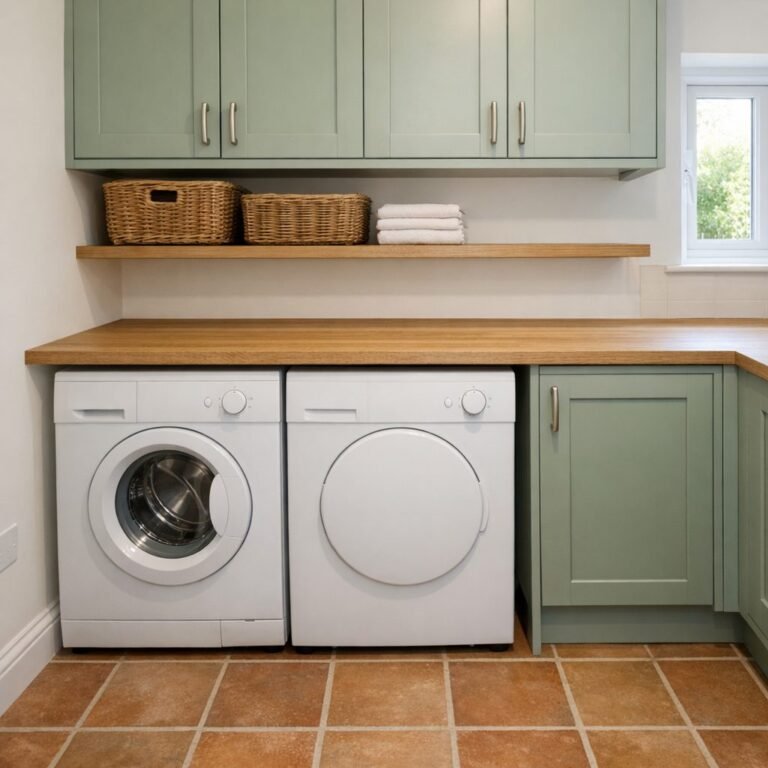
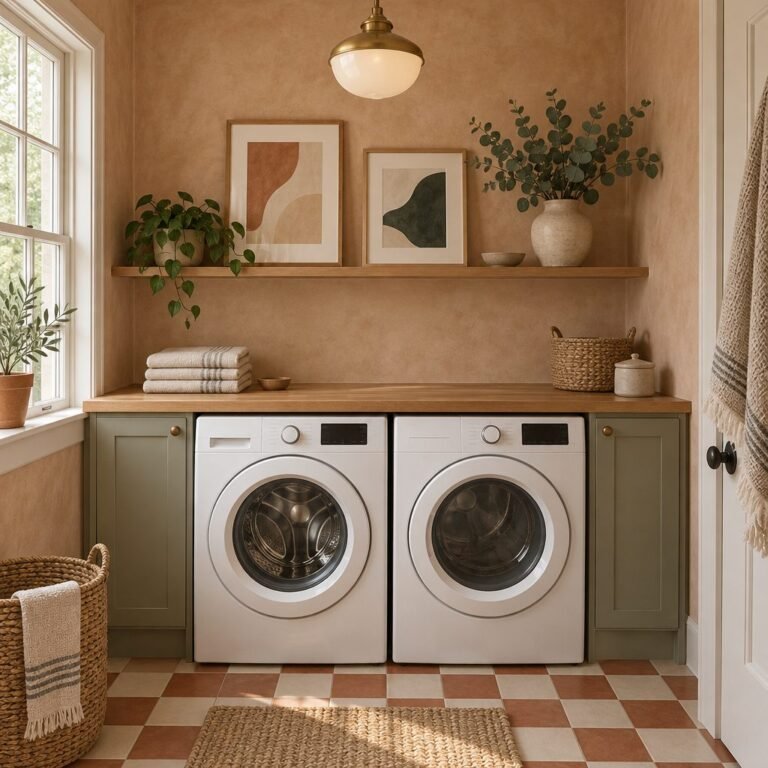
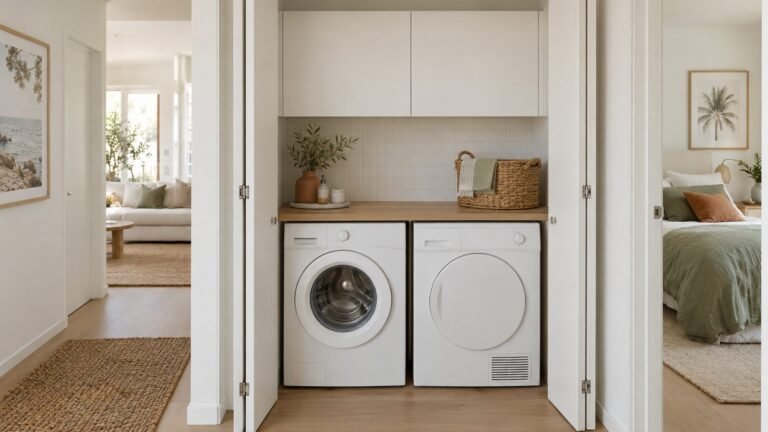
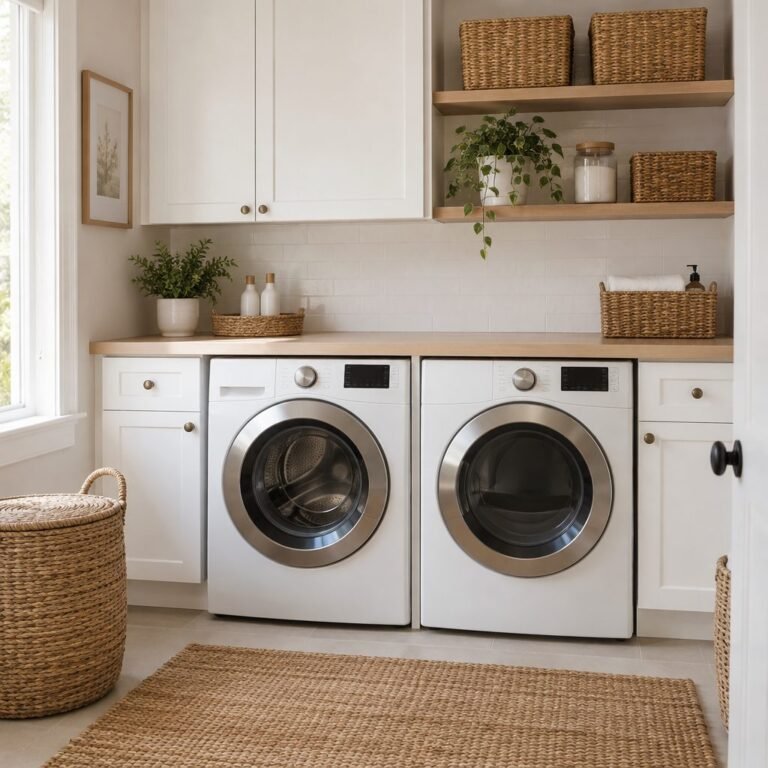
Laundry closet ideas are for homes where the washer and dryer did not get a room of their own. They live behind a pair of doors in the hallway, in a corner of the bathroom or at the end of the kitchen, and every inch around them has to work. The good news is that a closet is often enough for a perfectly pleasant laundry setup, as long as the machines fit, the air can move and the storage goes up instead of out.
This guide starts with the measurements that decide what fits, then walks through 18 ideas for doors, hallway closets, tiny closets, closets in other rooms and smart storage. If you have a full room to work with, our small laundry room ideas guide goes deeper on layouts.
Key Takeaways
- Quick answer: The best laundry closet ideas start with the right fit (about 57 inches wide for side-by-side front-loaders, 29 inches for a stacked full-size pair or 26 inches for a stacked compact pair), then add vented doors, a counter or shelf above the machines and slim storage on the side walls.
- Leave about 1 inch at each side and 6 inches behind the machines for hoses and the dryer vent, and make sure the closet doors can open fully.
- Use the height: stacking, shelves above the machines and a hanging rod do more in a closet than any bin on the floor.
Time: a weekend (longer for new hookups or a pocket door) · Cost: $50–1,500, more if you add hookups · Difficulty: Easy to moderate
How Much Space Does a Laundry Closet Need?
Before you buy shelves or doors, measure the inside of the closet: width, depth and height. Then compare those numbers with the machines you have or plan to buy. Whirlpool’s laundry sizing guide lists typical full-size front-loaders at about 27 inches wide, 39 inches high and 32 to 34 inches deep, and compact models at about 24 inches wide. It recommends about 1 inch of space on each side and 6 inches behind the machines for ventilation and hose connections, and it reminds you to check that closet doors can open and close fully.
Put together, two full-size front-loaders side by side need roughly 57 inches of width, a stacked pair needs about 29 inches, and a stacked compact pair about 26 inches. For depth, add 6 inches to the depth of the machines, which gives about 38 to 40 inches for full-size front-loaders. A stacked full-size pair stands roughly 75 to 78 inches tall, so in a closet with an 8-foot ceiling there is still room for a shelf or a short cabinet above.
Airflow matters as much as size. The installation specs in Whirlpool’s electric dryer dimension guide state that a closet installation with a door needs ventilation openings in the top and bottom of the door, and that louvered doors with equivalent openings are acceptable. The exact opening sizes and minimum clearances vary by model, so check the manual for your dryer before you build. If you are still choosing machines, our washer and dryer space calculator checks a space against these numbers for you.
Quick Pick: Which Laundry Closet Setup Fits Your Space?
| Your closet | Best setup | Ideas to start with |
|---|---|---|
| Hallway closet, 5 feet wide or more | Side-by-side front-loaders with a counter | #1, #5, #6, #7 |
| Narrow closet, about 30 to 42 inches wide | Stacked full-size pair | #2, #9, #10, #11 |
| Very tight closet or bathroom nook | Stacked compact pair | #12, #15, #17 |
| Closet next to a bedroom or living area | Vented doors and a level, quiet setup | #1, #3, #8 |
| Spare reach-in closet with no hookups | Talk to a plumber and electrician first | #14 |
How to Plan a Laundry Closet in 6 Steps
- Measure the inside of the closet. Note the width at the narrowest point, the depth from the back wall to the door frame, and the ceiling height.
- Check the machines against the space. Add about 1 inch at each side and 6 inches behind, then confirm the closet doors and the machine doors can both open fully.
- Check hookups and venting. You need a water supply, a drain, the right outlet (or gas line) and a route for the dryer vent to the outside, unless you choose a ventless dryer.
- Choose the doors. Pick a door style that leaves room in the hallway and has vent openings at the top and bottom, or louvers.
- Plan the storage vertically. Mark where a counter, shelves, a hanging rod and side shelves will go before you drill.
- Add the finishing touches. Lighting, paint or wallpaper, a drip pan and a few matching baskets make the closet easy to use every week.
Laundry Closet Door Ideas
The doors decide how much hallway space the closet takes and how well it breathes. These four options cover most homes.
1. Louvered Bifold Doors
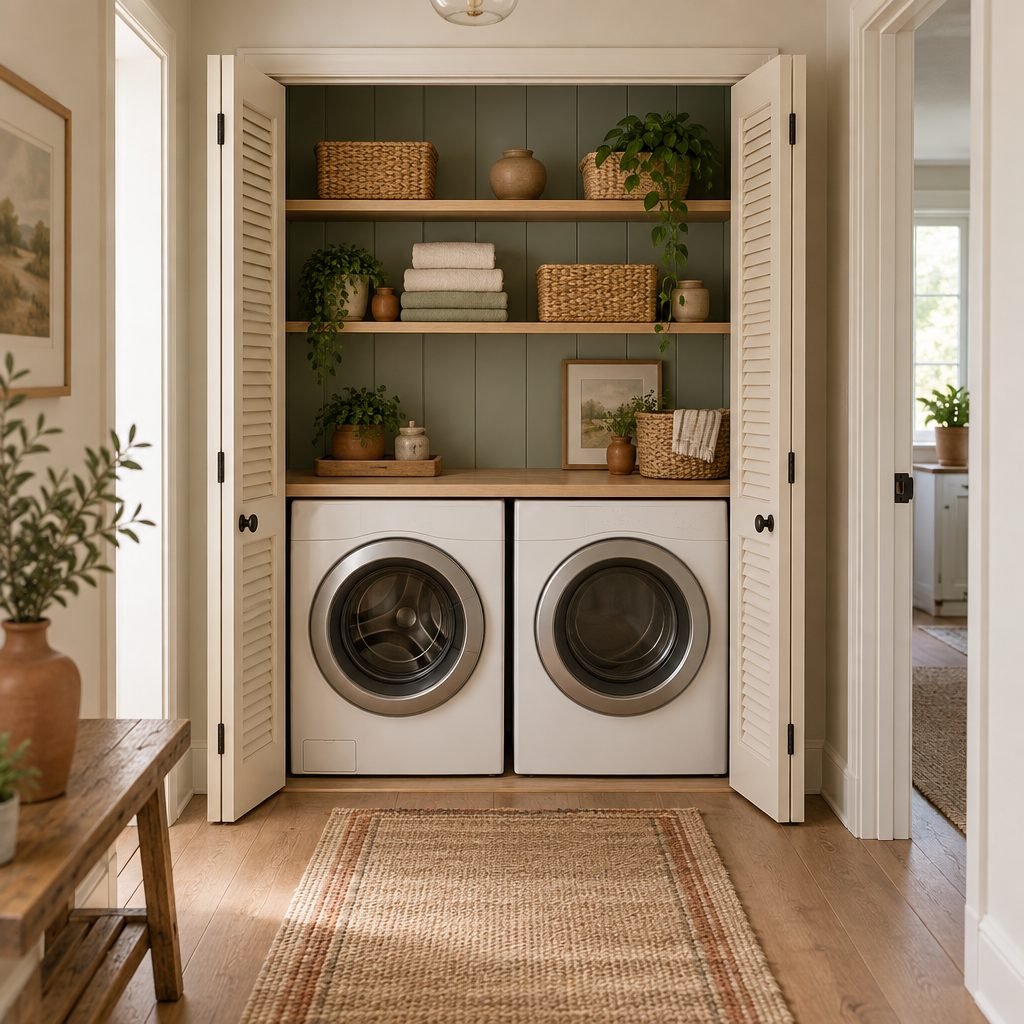
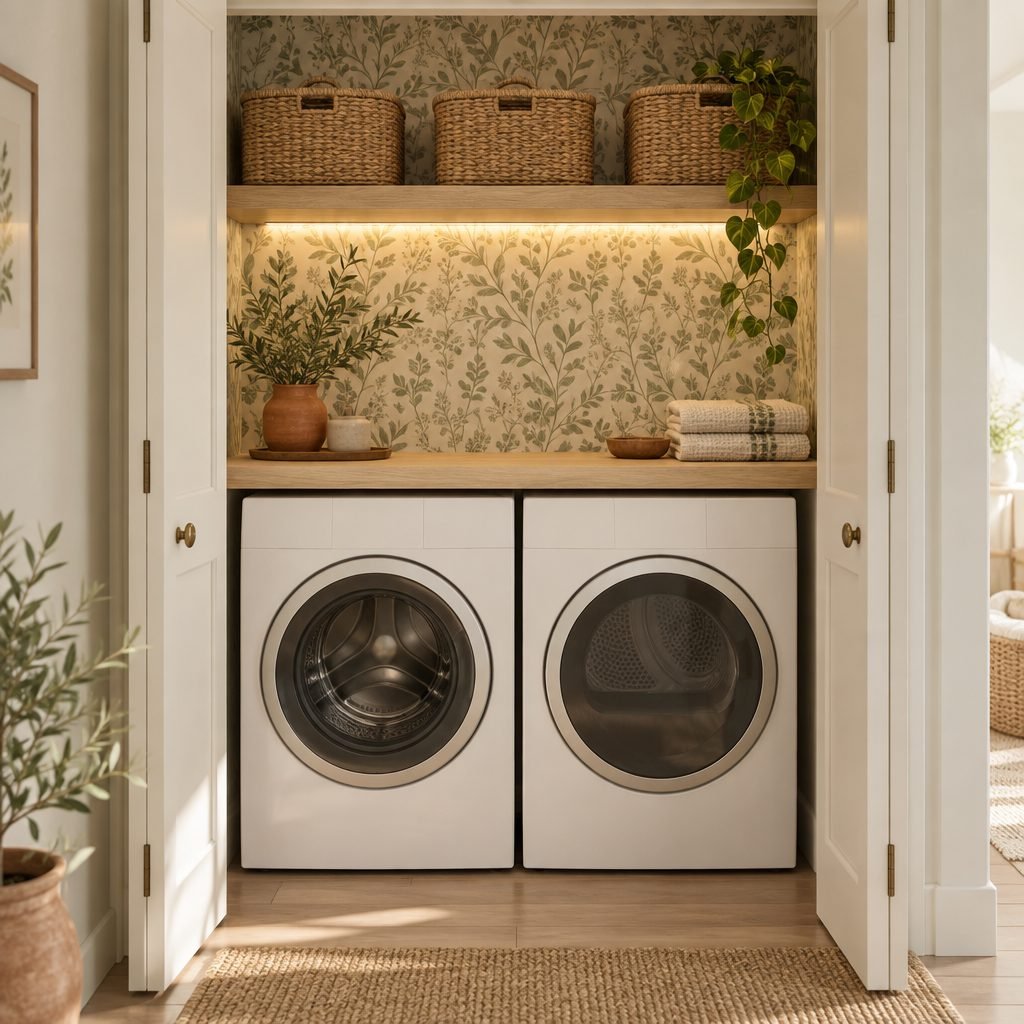
Louvered bifolds are the most common choice. The slats let air move in and out of the closet, and each door folds in half, so it needs only about half the swing space of a standard door. Paint them the same color as the hallway trim so the closet blends in, or pick a soft cream like the one in the photo at the top of this guide. Check that the folded doors do not block the front of the machines when they are open.
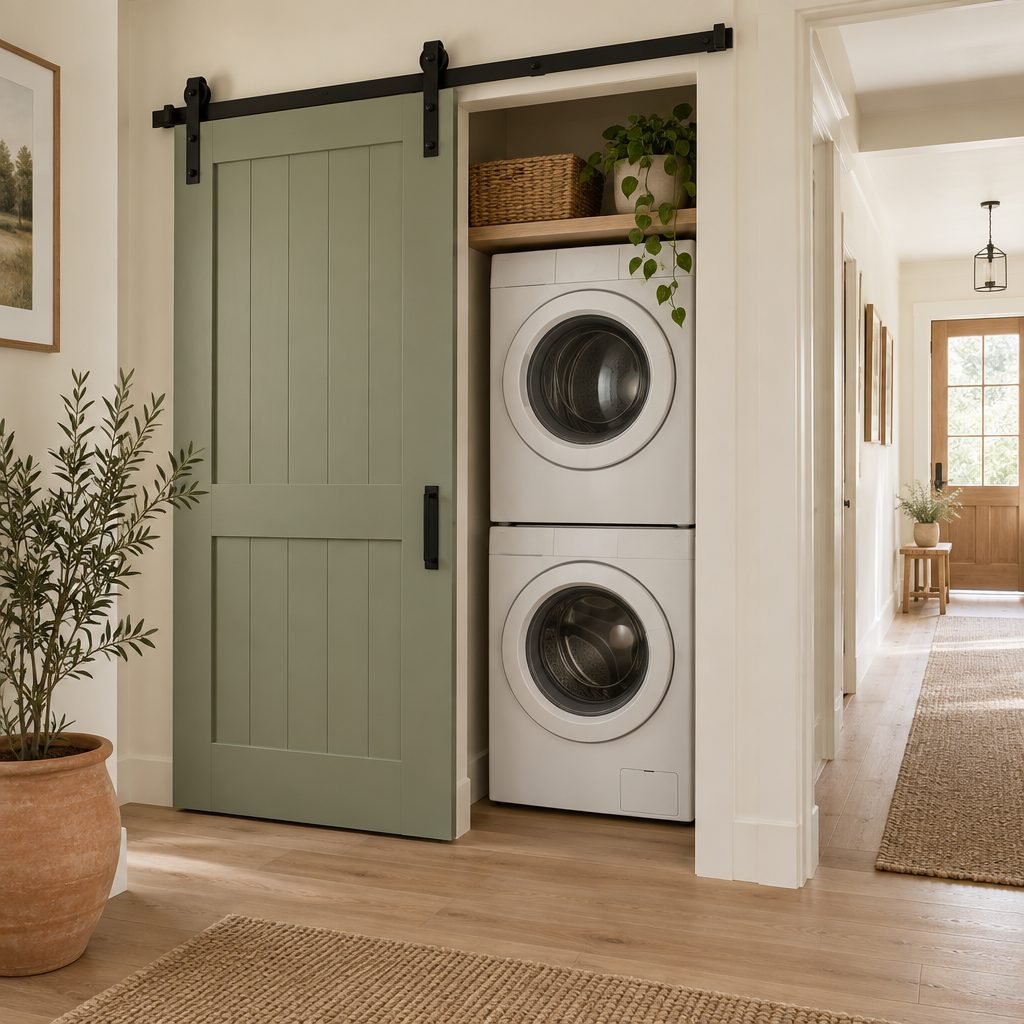
2. A Sliding Barn Door
A sliding barn door is a good fix when a swinging door would hit a wall, a radiator or the next doorway. It runs on a rail mounted above the opening and slides along the outside wall, so you need clear wall space beside the closet at least as wide as the door. Solid barn doors usually have a gap around the edges, but the dryer’s ventilation needs still apply, so compare the gaps with your manual or choose a door with vents built in.
3. A Pocket Door
A pocket door slides into the wall and disappears completely, which makes it the tidiest option in a narrow hallway. It is also the most work: the wall beside the closet must be opened up and be free of pipes, ducts and wiring. It suits a remodel more than a weekend project, and like any solid door it needs vent openings at the top and bottom if a dryer runs behind it.
4. Skip the Doors and Style It Open
If the closet faces a hallway that nobody sees from the front door, you can remove the doors altogether. Airflow around the machines is no longer a worry, and you can treat the space as a small open laundry nook with matching baskets and one or two plants. This works best when everything in the closet is part of the look, so plan for closed storage for the less pretty bottles. A linen curtain is another soft option, as in the before-and-after in our small laundry room guide.
Hallway Laundry Closet Ideas
A hallway laundry closet is on show every time you walk past, so it pays to make it look finished inside. These hallway laundry closet ideas also make the space easier to use.
Hallways bring two extra checks. First, the doors: measure how far they swing into the hallway and make sure they do not block a walkway or another door when open, which is why bifolds and sliding doors are popular here. Second, the route for the dryer vent: a closet in the middle of the home may be far from an outside wall, so plan the vent run before you choose a vented dryer, or consider a ventless washer and dryer in a closet that has no easy route outside.
5. Add a Counter Over Front-Loaders
If your front-loaders sit side by side, a counter about an inch above the machines turns the closet into a folding station. Use a butcher block or a sealed wood shelf supported on cleats along the side walls, not resting on the machines, so vibration does not shift it. You get a surface for folding and a spot to set down a basket of clean clothes. Top-loaders need about 2 feet of open space above the lid instead; our top-loading washer guide covers that layout.
6. Paint the Inside of the Closet
Painting only the inside of the closet is a small job with a big effect. A soft sage green, a warm terracotta or a deep blue makes the closet feel like a deliberate nook instead of a leftover space, and it hides scuffs better than flat white. Use a washable finish such as satin or semi-gloss, because laundry closets get damp and dusty.
7. Wallpaper and an LED Strip
Wallpaper is even more striking in a small space, and a closet needs only a roll or two. Choose a peel-and-stick or a vinyl-coated paper that can handle some humidity. Then add a plug-in or battery LED strip under the lowest shelf. Many laundry closets have one dim ceiling light, if any, and a strip of light right above the counter makes it far easier to spot stains and lost socks.
8. Keep It Quiet for the Rooms Nearby
Hallway laundry closets are often next to bedrooms, so noise matters. The biggest fix is making sure the washer is level, because an uneven machine shakes and walks during the spin cycle. Anti-vibration pads under the feet can help on hard floors. Run the machines during the day when you can, and leave enough space at the sides so the washer does not knock against the closet walls.
Small Laundry Closet Ideas
When the closet is narrow, stacking frees the most space. These small laundry closet ideas work around a stacked pair.
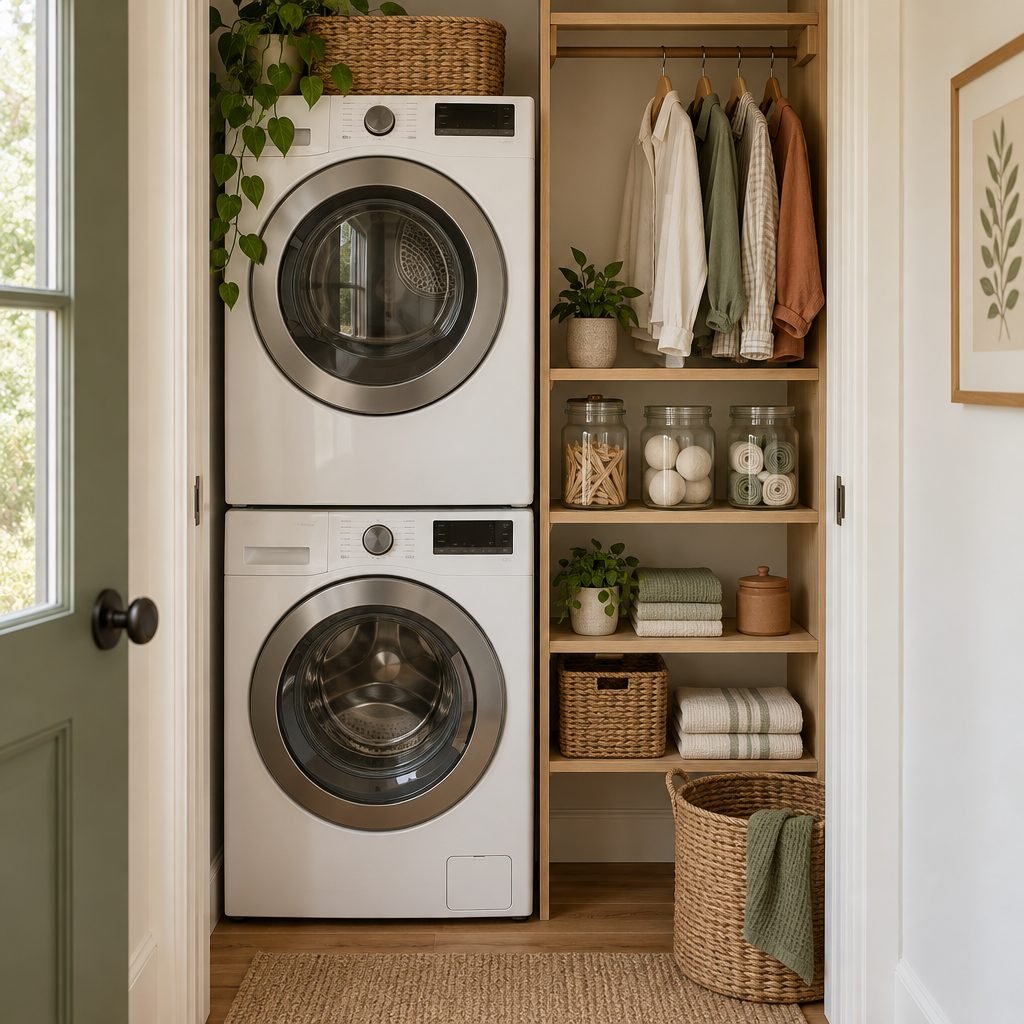
9. Stack the Machines and Add a Shelf Above
Many matching front-loading washer and dryer pairs can be stacked with the maker’s stacking kit, and that frees half of the floor. In a closet with an 8-foot ceiling, there is usually space above the stack for a shelf or a short cabinet for spare towels, dryer sheets and extra detergent. Keep the shelf high enough for the clearance your dryer manual lists above the machine, and use a step stool rather than climbing on the dryer. Whirlpool’s guide on how to stack a washer and dryer walks through the process.
10. Shallow Shelves on the Side Wall
If the closet is wider than the stack, the gap beside it is the most useful space you have. A column of shallow shelves, about 8 to 12 inches deep, holds jars of clothespins and dryer balls, rolled cloths and folded towels without blocking the machines. Shallow shelves keep everything in one row, so nothing gets lost at the back. Our DIY floating shelves tutorial works well for a closet wall.
11. A Hanging Rod for Air-Dry Clothes
A short rod is one of the most useful things in any laundry closet. Hang shirts straight out of the dryer so they do not wrinkle, or let delicate items drip-dry on hangers. Put the rod above the side shelves or across the closet above the counter, as long as it does not block a door or a dryer vent. If clothes pile up after laundry day, our guide on how to fold clothes to save space helps you put them away faster.
Laundry Closets in Other Rooms
A laundry closet does not have to be in a hallway. Some of the best laundry room closet ideas hide the machines in rooms that already have plumbing nearby.
12. A Bathroom Laundry Closet
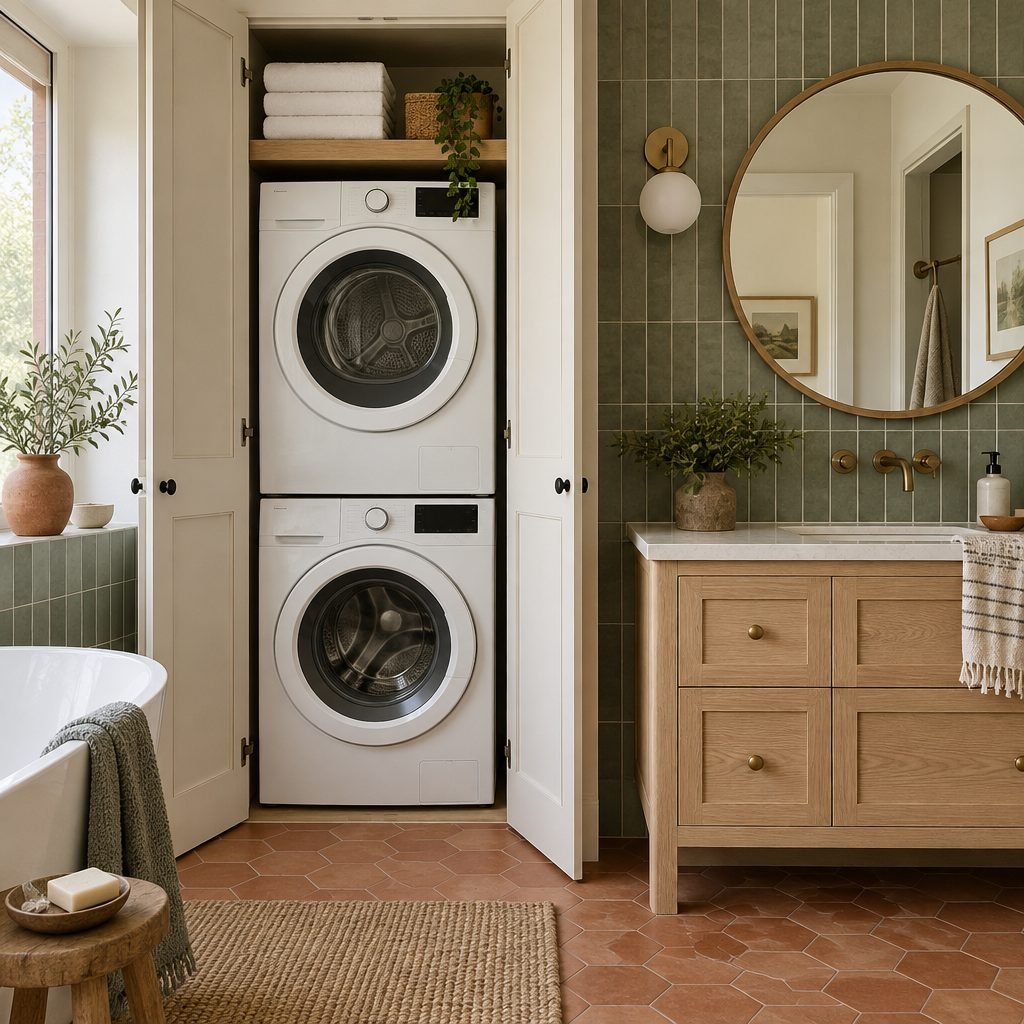
Bathrooms already have water supply and drains, which makes them a natural spot for a compact stacked pair. A tall closet or cabinet with doors keeps the machines out of sight, and an open shelf above holds towels where you need them. Compact 24-inch machines fit well here. Keep the closet doors vented, vent the dryer to the outside or choose a ventless model, and follow the manual on outlets and distances from water, since electrical rules for bathrooms are strict.
13. A Kitchen Laundry Closet
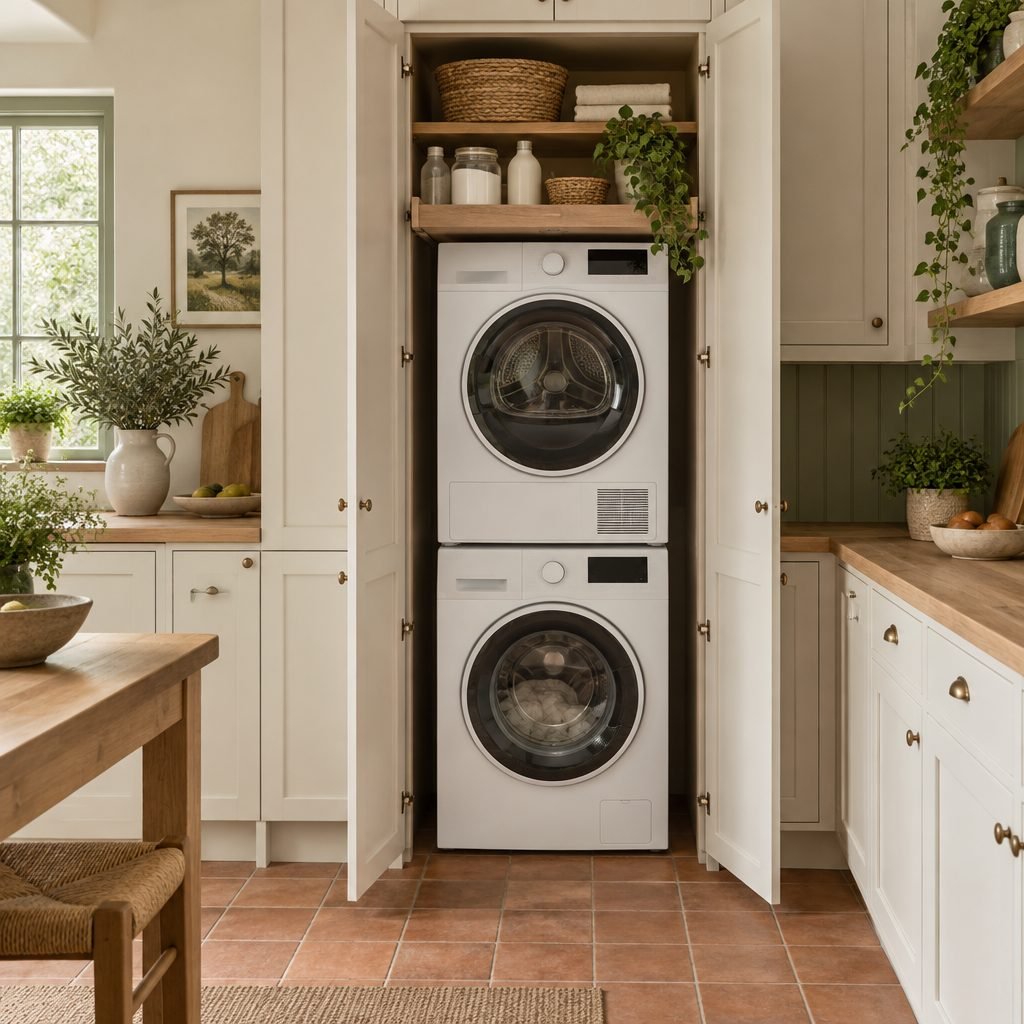
In many apartments and older homes, the laundry ends up in the kitchen. A tall pantry-style cabinet with full-height doors turns it into one more cabinet in the run. A pull-out shelf above the stack is handy for detergent and a jar of pods, and matching the cabinet doors to the rest of the kitchen hides the machines completely. Keep laundry products on a separate shelf from food so nothing gets mixed up.
14. Turn a Spare Reach-In Closet Into Laundry
A reach-in closet with no hookups can become a laundry closet, but this is a project for licensed pros. A plumber needs to add water supply and a drain, an electrician may need to add a dedicated circuit, and a regular dryer needs a vent route to the outside. If running a vent is not practical, a ventless condenser or heat pump dryer avoids it, though those still have their own clearance and drain needs. Check local permits before you start.
Closet Laundry Storage and Drying Ideas
Once the machines are in, these closet laundry ideas make the small space work every week.
15. A Retractable Clothesline
A retractable clothesline mounts on one closet wall and hooks onto the other when you need it. Pull it out for sweaters, swimwear and delicates, then let it roll back into its case so the closet looks empty again. A small peg rail beside it holds mesh wash bags for socks and lingerie. It is one of the cheapest upgrades in this list and saves floor space a drying rack would take.
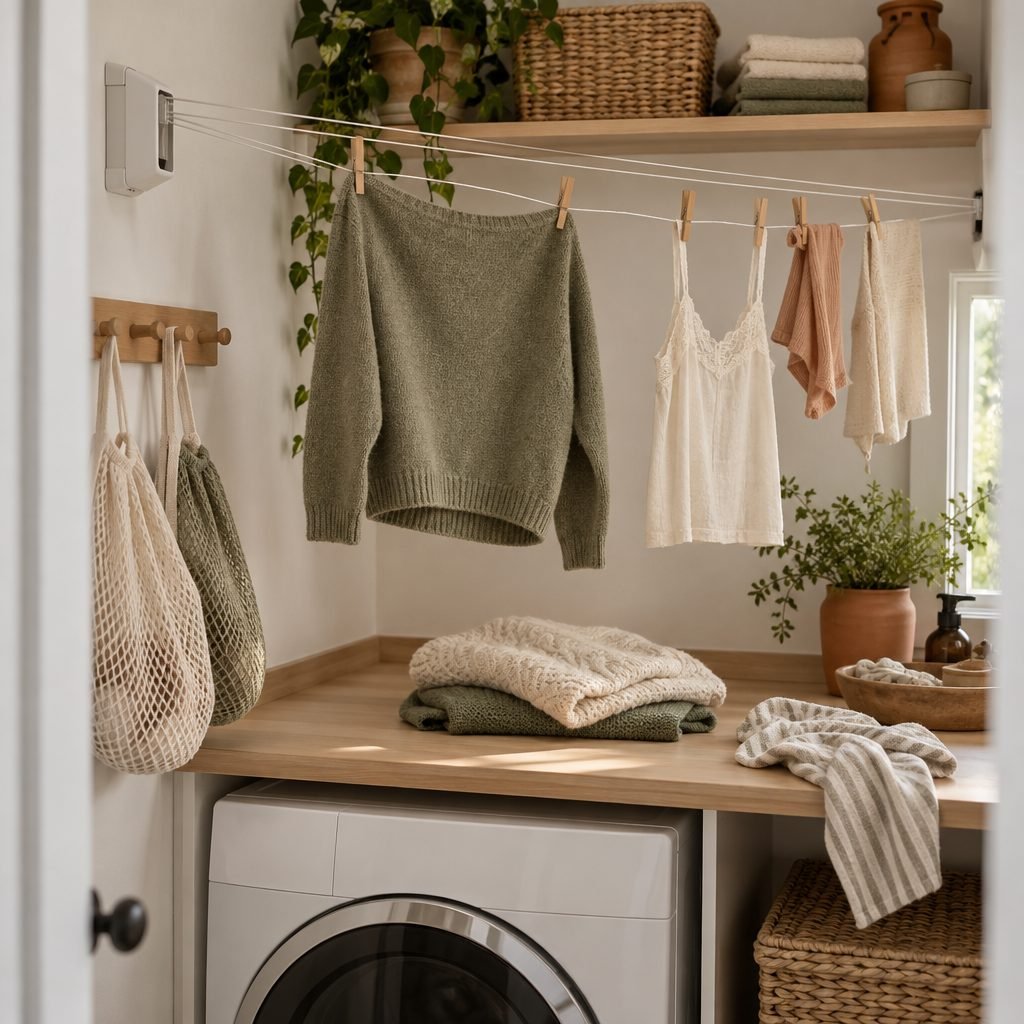
16. Use the Back of the Door
If your closet has swinging doors rather than bifolds, the back of each door is free storage. A slim over-the-door organizer holds spray bottles, stain remover, a lint roller and sponges. Check that it does not hit the machines or a shelf when the door closes, and keep heavy bottles near the bottom to protect the hinges. The same trick works in a coat closet.
17. Matching Baskets and Supplies Up High
A few matching baskets do more for a closet than any gadget. Use one for rags, one for lost socks and one for dryer balls and sheets. Keep detergent and laundry pods on a high shelf or in a cabinet out of children’s reach, never on the floor of the closet. Decanting powder into a jar looks tidy, but keep the original label or the instructions nearby.
18. A Drip Pan and a Leak Sensor
A laundry closet often sits next to a hallway floor or a bedroom wall, so a leak can cause damage before anyone notices. A washer drip pan under the machine catches small leaks, and a battery water sensor on the floor beside it sounds an alarm or sends a phone alert if water appears. Replace rubber fill hoses with braided ones when they look worn. These small parts protect the rest of the home.
Laundry Closet Mistakes to Avoid
- Solid doors with no vents. A dryer behind a solid closet door needs vent openings at the top and bottom, or louvered doors, as the installation instructions specify.
- Pushing the machines against the back wall. Without about 6 inches behind them, hoses can kink and the dryer vent can get crushed.
- Ignoring lint. The U.S. Fire Administration’s clothes dryer fire safety flyer says skipping the lint filter and vent cleaning raises the risk of a dryer fire. It advises cleaning the lint filter before and after each cycle and checking that the vent behind the dryer is not crushed or restricted.
- Storing things on top of the dryer. Bottles and baskets fall off with the vibration, and the top of the dryer gets warm. Use a shelf instead.
- Doors that block the machines. Folded bifolds or a door that swings into the closet can stop the washer door from opening fully.
- Measuring only the width. Depth and height decide whether the closet doors close and whether a stack fits under a shelf.
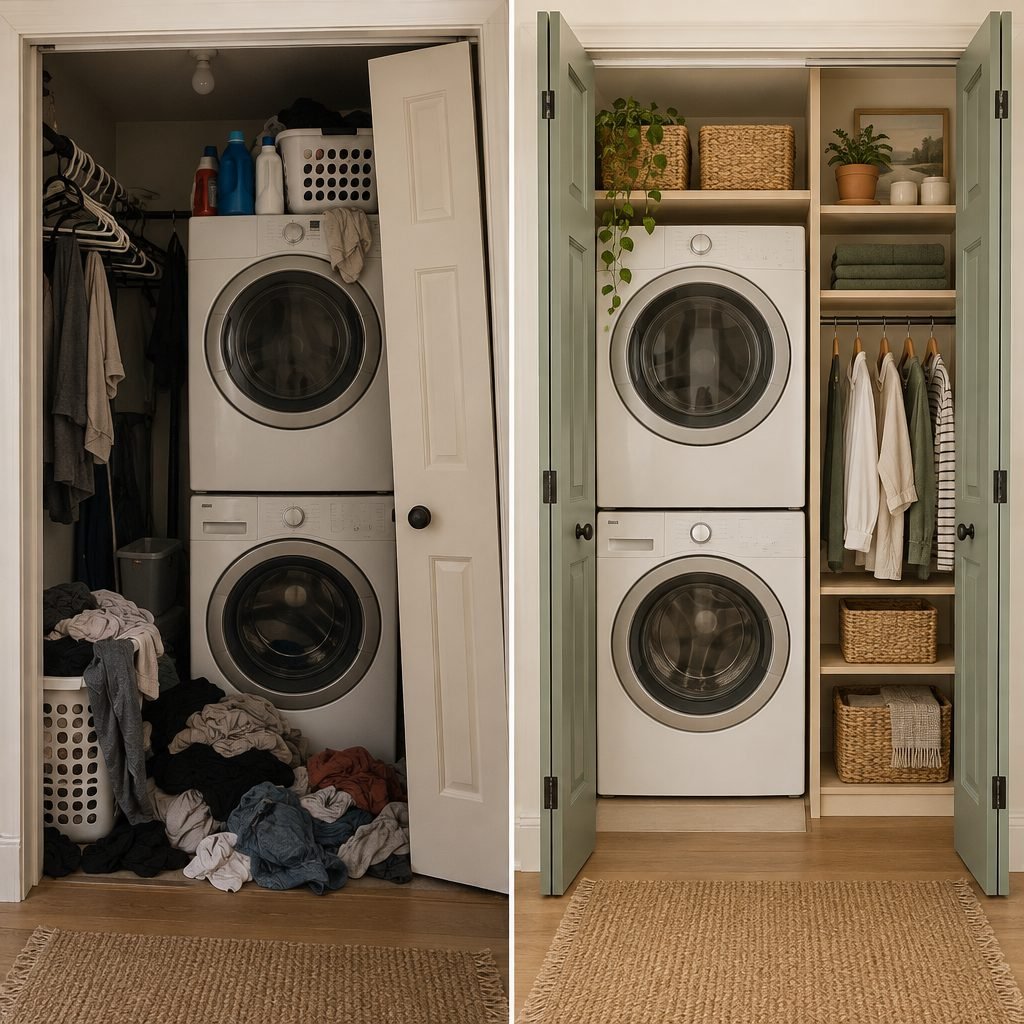
Like the idea of a laundry behind doors? Our European laundry ideas show how to fit a washer, dryer and small tub into a cupboard with folding or sliding doors, with the sizes for side-by-side and stacked layouts.
Laundry Closet FAQ
How much space do you need for a laundry closet?
For two full-size front-loaders side by side, plan on about 57 inches of width and 38 to 40 inches of depth. A stacked full-size pair needs about 29 inches of width with the same depth, and a stacked compact pair about 26 inches wide and 30 to 32 inches deep. Always check the exact clearances in your machines’ manuals.
Can you put a washer and dryer in a closet?
Yes, many washers and dryers are approved for closet installation. The closet needs water supply, a drain, the right power or gas connection and, for a vented dryer, a vent route to the outside. The door must have ventilation openings at the top and bottom or louvers, and the space must meet the clearances in the installation instructions.
Do laundry closet doors need to be louvered?
Not necessarily louvered, but they do need to let air in and out when a dryer is inside. Whirlpool’s installation specs call for ventilation openings in the top and bottom of a closet door and accept louvered doors with equivalent openings. Check your dryer’s manual for the exact sizes.
How do I make a hallway laundry closet look nicer?
Paint or wallpaper the inside, add a wood counter or shelf above the machines, swap mixed bottles for a few matching baskets and add an LED strip under a shelf. Doors that match the hallway trim help the closet blend in when it is closed.
How do you hide a washer and dryer in a hallway?
Hide them behind closet doors, such as louvered bifolds, a sliding barn door or a pocket door. In a narrow hallway, pocket and sliding doors need no swing space, and bifolds need about half. Whatever you choose, the doors need vent openings at the top and bottom, or louvers, if a dryer runs inside.
Can you put a washer and dryer in a bathroom?
Yes, a bathroom is a natural spot because the water supply and drain are already nearby. A compact 24-inch stacked pair fits well in a tall closet or cabinet with vented doors. Vent the dryer outside or choose a ventless model, and follow the manual on outlets and distance from water.
How do you hide a washer and dryer in a kitchen?
Put a stacked pair inside a tall pantry-style cabinet with full-height doors that match the rest of the kitchen, so it looks like one more cabinet. A pull-out shelf above the stack holds detergent, and keeping laundry products on their own shelf stops them from getting mixed up with food.
Final Thoughts
The best laundry closet ideas start with a tape measure, not a shopping list. Once you know the machines fit with room for hoses and airflow, a counter, a column of shallow shelves and a hanging rod can turn a plain closet into a laundry spot that works every week. Pick one idea for the doors and one for storage, and build from there.
For more ways to plan a small laundry space, see our guides to laundry room cabinet ideas, how to organize a laundry room and linen closet organization.
How this guide was made: researched and written with the help of AI tools, fact-checked against trusted sources and published by Mohamed Elber. Images are AI-generated illustrations. See our Editorial Policy.